

NYT:
Major stock indexes have set record after record in recent years, fueled by seemingly boundless appetite among investors for anything connected to artificial intelligence. The total value of the U.S. stock market has more than doubled over the past decade to over $75 trillion, roughly two and a half times the annual output of the entire U.S. economy, itself a record ratio.
Much of that value exists only on paper, bets on future profits that may or may not materialize in the years ahead. But the boom is supporting real economic activity today, pumping trillions of dollars of investment into semiconductor factories, data centers, power plants and transmission lines. And the wealth it is creating is helping to drive consumer spending, particularly among affluent Americans, whose appreciating stock portfolios make them more willing to shell out for luxury vacations, pricey electronics and meals at high-end restaurants.
[…]
“The thing that has been holding everything up is the A.I. story,” said Torsten Slok, the chief economist at Apollo Global Management.
A.I. related stocks account for roughly half of the rise in the S&P 500 this year, said Adam Turnquist, the chief technical strategist for LPL Financial, adding that growth in the economy is also increasingly dependent on A.I. infrastructure spending.
“It’s becoming one big A.I. trade,” he said.
[…]
The other distinguishing factor of the current market is how concentrated it is in a handful of companies. The Magnificent Seven group of companies of Meta, Alphabet, Amazon, Apple, Tesla, Nvidia and Microsoft account for roughly a quarter of the value of all publicly listed stocks in the United States.
Now ask yourself, What is the meaning of life?
Stanley Hauerwas (2003):
Christians are not called to be heroes or shoppers. We are called to be holy. We do not think holiness is an individual achievement, but rather a set of practices to sustain a people who refuse to have their lives determined by the fear and denial of death. We believe by so living we offer our non-Christian brothers and sisters an alternative to all politics based on the denial of death. Christians are acutely aware that we seldom are faithful to the gifts God has given us, but we hope the confession of our sins is a sign of hope in a world without hope. This means pacifists do have a response to September 11, 2001. Our response is to continue living in a manner that witnesses to our belief that the world was not changed on September 11, 2001. The world was changed during the celebration of Passover in A.D. 33.
Mark and Louise Zwick, founders of the Houston Catholic Worker House of Hospitality, embody the life made possible by the death and resurrection of Jesus. They know, moreover, that Christian nonviolence cannot and must not be understood as a position that is no more than being “against violence.” If pacifism is no more than “not violence,” it betrays the form of life to which Christians believe they have been called by Christ. Drawing on Nicholas Berdyaev, the Zwicks rightly observe that “the split between the Gospel and our culture is the drama of our times,” but they also remind us that “one does not free persons by detaching them from the bonds that paralyze them: one frees persons by attaching them to their destiny.” Christian nonviolence is but another name for the friendship we believe God has made possible and constitutes the alternative to the violence that grips our lives.
Almost ye convince me. Well, not almost; he does convince me, but that conviction makes up the bulk of the 95% pacifist in me. As indicated before, to claim full commitment to pacifism or nonviolence would be to elevate a principle above the God-man Jesus, who conquered not through “nonviolence” — though it included that — but through his sacrificial, self-emptying philanthropia.
There is, in other words, a Christian nonviolence. But it is not the principle we serve. To my reading, this does not make Hauerwas’s argument any less true; it does submit it under the proper divine-humane authority.
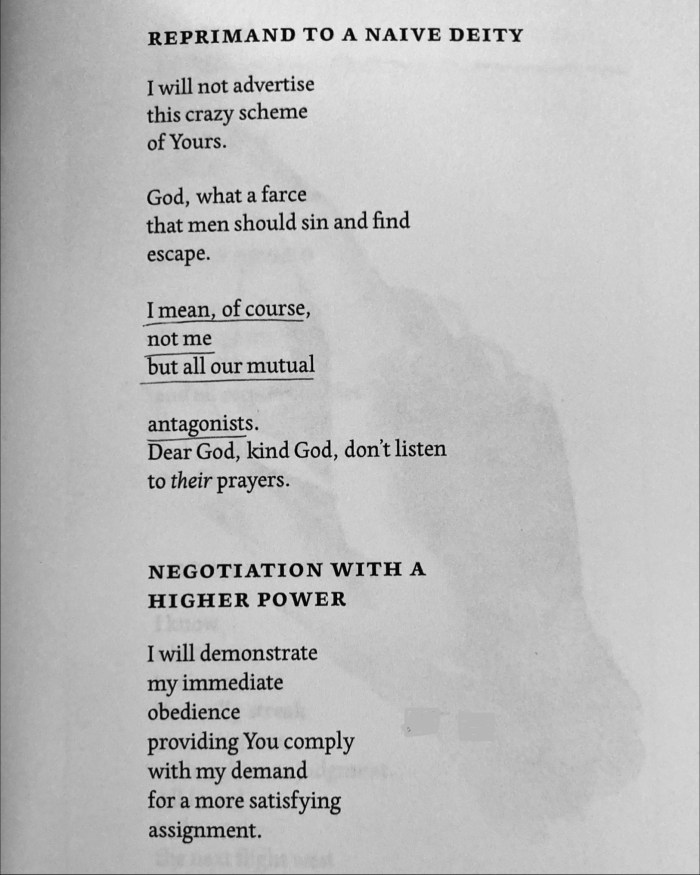
From Thomas John Carlisle’s You! Jonah!:
When the United States invaded Afghanistan in the immediate wake of al-Qaeda’s attacks on 9/11, it had a handful of drones, only a fraction of which were armed. America’s intelligence officers and special operations forces had a history of working together within the context of major wars or national crises but did not cooperate in their tactical or operational activities as a matter of course. U.S. officials typically viewed terrorism through the lens of law enforcement, emphasizing the collection of evidence in the wake of terrorist attacks with an intent to prosecute those responsible. Even those U.S. military units that had a dedicated counterterrorism mission spent most of their time conducting training and rehearsals for singular terrorist incidents, such as airplane hijackings or large-scale hostage events. The war in Afghanistan — and the Global War on Terror — changed all of that.
[…]
The record of adaptation and innovation in Afghanistan demonstrates an impressive ability of the U.S. military to learn tactical and technological lessons and to apply those in near real-time on the battlefield. The full potential of these technical advances would likely have remained unmet; however, had the U.S. government not also engendered a cultural revolution within its component agencies. Perhaps the most important cultural change — which was advanced by the task force in Afghanistan that was dedicated to counterterrorism but eventually spread broadly across U.S. military forces — was the fusion of intelligence and operations via the targeting cycle known as “Find-Fix-Finish-Exploit-Analyze-Disseminate.” In this cycle, U.S. forces used their intelligence tools to identify targets, raided or conducted drone strikes against those targets, and exploited the information gleaned from those raids or strikes to continue the cycle by generating more targets.
[…]
…for much of the war, the prevailing assumption of the U.S. military was that turning the targeting cycle ever faster — in other words, killing or capturing ever greater numbers of Taliban — would generate strategically beneficial effects.
This belief explains the almost fanatical zeal with which U.S. commanders of the war sought to increase the pace of raids and strikes against al-Qaeda, the Taliban, and (later in the war) the Islamic State. As described by a U.S. Navy SEAL: “The one thing I learned from McChrystal was if you can’t get quality, get quantity of missions.” The seemingly logical appeal of this attrition-centered approach, the seductiveness of its simple kill/capture metrics, and the consistent promotion of its practitioners and advocates within the U.S. military cemented the “find, fix, finish…” approach — and more generally, an operational model centered on lethality in overdrive — as the way for the U.S. military to conduct successful operations in the modern age.
[…]
Over the course of the war, America killed thousands of Taliban commanders and perhaps 10,000 or more of the group’s fighters. At the height of U.S. presence in Afghanistan, it was common for its counterterrorism forces to eliminate entire cells of the Taliban’s fighting structure in a matter of days. And yet, the group’s strength grew almost continuously in proportion to the length of the war, in direct defiance of lethal actions against it.
… the find, fix, finish model has its origins in theories for optimizing the destruction of physical systems (such as electrical grids or manufacturing networks), which can be effectively modeled because they follow well-understood laws of physics. The assumption that a model based on physical principles will apply equally well to human networks — and that it can yield reliable insights into how those networks might react to the removal of specific individuals via lethal targeting — is a fallacy of the first order. Humans and the interactions between them do not adhere to any analogous set of immutable laws or principles.
… There is a hard-wired assumption in this approach that only effects against the enemy matter, and U.S. intelligence assets and analysis in Afghanistan were therefore laser-focused on al-Qaeda and the Taliban — a fact that some U.S. military intelligence leaders openly admitted (and complained about) during the war. This assumption, however, ignores the impact of lethal actions on non-enemy civilian populations. At various times in Afghanistan, one can find publicly–cited estimates of the so-called “jackpot” rate — meaning the percentage of raids or strikes that netted their intended target — ranging from 50 percent to as high as 95 percent.
In no case, however, was the jackpot rate 100 percent. This meant that throughout the war, U.S. forces were consistently and mistakenly raiding and striking the homes of civilians who had little if anything to do with al-Qaeda or the Taliban. An unknown fraction of those incidents resulted in the death or injury of those civilians, but even in cases in which physical harm did not accrue, those civilians nonetheless carried away at least some degree of mental anguish from having been wrongfully targeted.
In Afghanistan, the U.S. military believed that an ever-faster rate of lethal raids and strikes — in line with the find, fix, finish model — would generate predictably crippling effects on its enemies. Had the military instead employed a more holistic operational model that sought a nuanced understanding and analysis of the structure of both the Taliban and Afghanistan’s civilian networks, it might have been able to see in real time what is evident in hindsight: the application of industrial-scale lethal actions against the Taliban, and the consistent drumbeat of civilian harm that accompanied it, was — in contrast to Petraeus’ assertion — counterproductive to U.S. counterinsurgency goals in the war.
Genuine credit should be given for sober analysis, but it’s worth pointing out the obvious. I have, as one example, a book on the shelf called Dissent From the Homeland: Essays After September 11. It contains the voices of Stanley Hauerwas, Robert Bellah, Wendell Berry, Rowan Williams, and over a dozen others, and it was published in 2003. So it should be noted that this is not limited to “hindsight”; many (myself, I confess, excluded) saw it not just “in real time” but saw it responsibly and prophetically.
What Susan Sontag wrote on September 16, 2001, for instance, is worth remembering:
Politics, the politics of a democracy—which entails disagreement, which promotes candor—has been replaced by psychotherapy. Let’s by all means grieve together. But let’s not be stupid together. A few shreds of historical awareness might help us understand what has just happened, and what may continue to happen. “Our country is strong,” we are told again and again. I for one don’t find this entirely consoling. Who doubts that America is strong? But that’s not all America has to be.
Then again, why would we listen to a writer like Sontag or a pacifist like Hauerwas when we can send the military to learn its lessons and our lessons in hindsight?
Schroden continues:
America has continued its emphasis on technological innovation with impressive tactical results. It has become increasingly enamored of the use of AI to help it more efficiently analyze intelligence, generate targets, and assess the effects of those targets having been struck. In particular, the MAVEN Smart System — which grew out of Project Maven, an effort that was initially focused on improving lethal counterterrorism targeting — has been increasingly integrated into the U.S. military’s analysis and decision processes, all with the goal of further speeding up the lethal targeting cycle. This enabled U.S. forces to strike well over 1,000 targets in Iran during the war’s first 24 hours, a more than tenfold increase from what it could do before.
The United States has also increasingly integrated the use of unmanned systems into its operations, going well beyond the use of drones for airborne intelligence gathering and limited strike purposes by employing surface drones (e.g., for strike and rescue operations) and underwater drones (e.g., for mine clearing). It has even gone so far as to reverse-engineer Iran’s famous Shahed drones and to use them as a cheap direct-attack munition.
Yet, the U.S. government continues to see the application of lethal military power as the path to victory against Iran. It has struck many thousands of physical targets, including the wholesale sinking of Iran’s conventional navy. Israel, its partner in the war, killed Iran’s supreme leader on the war’s first day and has continued targeting high-level leaders in the Iranian government since then. These operations have resulted in a remarkable degree of destruction within Iran. They have also resulted in the deaths of hundreds of civilians that we know of and undoubtedly scores more that have not been publicly reported.
And he concludes:
The overarching lesson that U.S. leaders should learn from our experience of the past 25 years is that dogged pursuit of overwhelming attrition is not a reliable pathway to success, and blind faith in lethality is strategic folly. And yet, the lesson they seem to have actually learned is to employ every technological means available to destroy things and kill people at an ever-faster pace, in the belief that war is little more than “fighting to win.”
The upcoming milestones of the Afghanistan withdrawal and the attacks of 9/11 should be national moments of reflection on their own merits. This year, though, I believe they should be even more than that. These are moments of national crisis, given that we are once again losing a war of our choosing.
[…]
If insanity is repeating the same actions and expecting different results, the U.S. way of war is nuts. As we approach the milestones of the Afghanistan withdrawal and 9/11, let us pause — really stop and think — and have a national discussion on how we walked ourselves into the asylum of lethality, and how best to get back out.
Nota bene, the above piece is from War on the Rocks — for anyone familiar, not exactly a pacifist or anti-military platform. Nor am I, Berry and Hauerwas student that I am, strictly speaking a pacifist. 95% pacifist is what I can claim: it’s far reaching, sacrificial and serious, but it leaves unclaimed — undefined or at least less defined — a very complex, open, and, yes, “realist” 5%.
But it should be worth noting the overlap between the warnings of pacifists/pacifist-adjacent folks (Sontag was not exactly a pacifist) and the military lessons learned in hindsight.
I don’t trust my memory enough to say whether I watched the second plane hit that day. I do know that both towers were still standing when they rolled that TV stand into Mr. Kohl’s history classroom my junior year of high school. When I joined the Air Force a year later, it was on a whim. I recall no strong sense of duty, much less of anger or desire for revenge or justice or whatever. I had a friend who had always wanted to join the Air Force. A few of us simply tagged along with him to the guidance counselor’s offices to talk to a recruiter who came to school. A month or so later we were taking the ASVAB and signing the forms, co-signed by our parents since we were still 17 years old.
Like many, I do remember eventually sitting quite complacently within the zeitgeist of pathetically questioned National Pride, Etc. In July of 2003 I stood in church on Sunday in basic training at Lackland Air Force Base in San Antonio and listened to one of our commanders remind us that “we are here to break things and kill people.” I don’t recall this striking any of us there as wrong in any sense; we the mission-focused believed it to be true and found it inspiring.
I have written some about my grapple with that speech while sitting bedside with a little girl in Mosul, Iraq fourteen years later. And I have written some about the “tele-murder” we still call “war” and the sheer moral laziness with which we all confront it.
“Do we have a population trained well enough in the habits of sacrifice to make just war possible?” Hauerwas once asked. Do we? Are we such justice-enabling members of the world? Am I?
More than anything else today, what I’m thinking about and what I want to say is that the bar for honesty and integrity is lower (i.e. more human and achievable) than we often allow it to be. It’s got nothing to do with left or right, conservative or liberal, realism or localism or globalism. The hardest military veteran can see it as well as the staunchest pacifist. All it takes is a moment — and who knows where these moments come from — with the will to step back from what Catherine Lutz called the “crazy quilt of antagonism.”
“All the stories in the world surround us,” wrote David James Duncan in the book mentioned above. “We’re in a kiln with India, Pakistan, Israel, Palestine, Iraq, Mobil, Shell, and Exxon. Even if we’ve no power to guide the firing, we possess the power to think infinitely more clearly and compassionately than Dan Rather, power to empathize, power to consume less and to consume more peacably.”
“The time will soon come,” Wendell Berry wrote in December 2001, “when we will not be able to remember the horrors of September 11 without remembering also the unquestioning technological and economic optimism that ended on that day.”
That time, sadly, has not yet come. But it can come for any of us at any time of any day. The lessons are right there, if we desire to learn them. And mercy, mercy, mercy, we pray, for those of us who take longer to learn them.
I went down in the river to pray,
Studyin’ about that good ol’ way,
An’ who shall wear the starry crown,
Good Lord, show me the way.
O mourner, let’s go down, let’s go down, let’s go down,
O mourner, let’s go down,
Down in the river to pray.
Wendell Berry (originally published in December 2001):
The time will soon come when we will not be able to remember the horrors of September 11 without remembering also the unquestioning technological and economic optimism that ended on that day.
[…]
We did not anticipate anything like what has now happened. We did not foresee that all our sequence of innovations might be at once overridden by a greater one: the invention of a new kind of war that would turn our previous innovations against us, discovering and exploiting the debits and the dangers that we had ignored. We never considered the possibility that we might be trapped in the webwork of communication and transport that was supposed to make us free.
[…]
National self-righteousness, like personal self-righteousness, is a mistake. It is misleading. It is a sign of weakness. Any war that we may make now against terrorism will come as a new installment in a history of war in which we have fully participated. We are not innocent of making war against civilian populations. The modern doctrine of such warfare was set forth and enacted by General William Tecumseh Sherman, who held that a civilian population could be declared guilty and rightly subjected to military punishment. We have never repudiated that doctrine.
It is a mistake also – as events since September 11 have shown – to suppose that a government can promote and participate in a global economy and at the same time act exclusively in its own interest by abrogating its international treaties and standing apart from international cooperation on moral issues.
[…]
In a time such as this, when we have been seriously and most cruelly hurt by those who hate us, and when we must consider ourselves to be gravely threatened by those same people, it is hard to speak of the ways of peace and to remember that Christ enjoined us to love our enemies, but this is no less necessary for being difficult.
[…]
What leads to peace is not violence but peaceableness, which is not passivity, but an alert, informed, practiced, and active state of being. We should recognize that while we have extravagantly subsidized the means of war, we have almost totally neglected the ways of peaceableness. We have, for example, several national military academies, but not one peace academy. We have ignored the teachings and the examples of Christ, Gandhi, Martin Luther King, and other peaceable leaders. And here we have an inescapable duty to notice also that war is profitable, whereas the means of peaceableness, being cheap or free, make no money.
[…]
The complexity of our present trouble suggests as never before that we need to change our present concept of education. Education is not properly an industry, and its proper use is not to serve industries, either by job-training or by industry-subsidized research. It’s proper use is to enable citizens to live lives that are economically, politically, socially, and culturally responsible. This cannot be done by gathering or “accessing” what we now call “information” – which is to say facts without context and therefore without priority. A proper education enables young people to put their lives in order, which means knowing what things are more important than other things; it means putting first things first.
The first thing we must begin to teach our children (and learn ourselves) is that we cannot spend and consume endlessly. We have got to learn to save and conserve. We do need a “new economy”, but one that is founded on thrift and care, on saving and conserving, not on excess and waste. An economy based on waste is inherently and hopelessly violent, and war is its inevitable by-product. We need a peaceable economy.
I don’t think I have picked up Wendell Berry’s collection What Are People For? since I bought it in 2018. Here he writes (in 1975!) in praise of Nate Shaw and against what we might now call the ubiquitous voice of R. Buckminster Fuller:
Shaw’s vocabulary and usage will sometimes seem strange to readers not familiar with his region and way of life, but it will never seem empty or inert. When he speaks of “correspondin” a girl or says that his son “got stout enough to accomplish a place,” we have no trouble understanding what he means, and we are also aware that his words convey insight beyond the reach of conventional usage. He speaks always in reference to a real world, thoroughly experienced and understood. His words keep an almost physical hold on “what I have touched with my hands and what have touched me. . . ” Surely this is the power that we have periodically sensed in what is called (vulgarly) “the vulgar tongue.” It is a language under the discipline of experience, not of ideas or rules. Shaw’s words, always interposed between experience and intelligence, have the exactitude of conviction, whereas the words of an analyst or theorist can have only the exactitude of definition.
In a recent issue of Saturday Review/World, R. Buckminster Fuller has an article called “Cutting the Metabilical Cord,” which is based on a virtually unqualified assumption that humanity has begun a process of unlimited improvement by way of technological progress. “Humanity knew very little when I was young,” he says. And he recalls the “skilled craftsmen” he worked with on his first jobs; these people “had vocabularies of only about 100 words, many of which were blasphemous or obscene.” Thanks to radio and television, however, this lamentable ignorance has been corrected by a “historic information-education explosion and its spontaneous edifying of humans in general.” This “explosion” of edification “completely changed the speech pattern of world-around humanity from that of an illiterate ignoramus to that of a scholar.” These and many similar assertions culminate in a sort of Creed for Modern Times: “The great intellectual integrity of universe has cut the metabilical cord of tradition and parental authority—putting youth on its own thinking responsibility.” And then occurs the essay’s only note of caution, which is immediately buried beneath another avalanche of technological mysticism: the young people of 1974, “whose metabilical cord of tradition has been cut, now need a few years time to develop competence to take over the world affairs initiative, and that is exactly what universe is apparently about to do next.”
It may be that Mr. Fuller’s language can be put to some good use. I hope so. It could certainly be used to promote the sale of television sets. Should his jargon catch on with the public, it could also be useful to any politician whose designs required a fit of public optimism. This gobbledygook of “universe” is representative of a lot of the sub-tongues spoken now by people who lead “awesome intellectual lives.” It is speech so abstract, so far removed from anybody’s experience, that it is virtually out of control; anything can be said in it that the speaker has the foolishness or the audacity to say.
There is not a phrase in Nate Shaw’s story so abstract, naive, ignorant, insipid, or tasteless as this language of Buckminster Fuller. An “uneducated” man whose speech was formed long before radio, Shaw is nevertheless well able to say whatever he thinks, and he thinks whatever he needs to think as a man of exceptional competence, both practical and moral. In moments of joy or grief, he is capable of a sort of poetry. The burden—and so the discipline—of Shaw’s language is what he knows from experience. For that reason nothing he says, if correctly quoted, will ever be useful to a salesman or a political propagandist. There is not a single slogan in this book. He has no talk of “education explosions” or “metabilical cords.” He does not say “Freedom now” or “Black is beautiful” or “Power to the people.” He says: “My color, the colored race of people on earth, goin to shed theirselves of these slavery ways. But it takes many a trip to the river to get clean.” He says: “They goin to win! They goin to win! But it’s goin to take a great effort . . . . It won’t come easy. Somebody got to move and remove . . . . It’s goin to take thousands and millions of words, thousands and millions of steps . . . . And I hope to God that I won’t be one of the slackers that would set down and refuse to labor to that end.”
That is eminently responsible language. And it is deeply moving—especially when we realize that the man speaking almost in the same breath of faith, doubt, difficulty, and his own willingness to labor is eighty-six or-seven years old. The movement here is characteristic: the swiftly defined hope or vision or ambition, followed by the recognition of difficulty, the implication of labor. And these passages occur among stories that reveal the nature and the difficulty of effort and the characters of people, black and white. What this responsibility rests on is the knowledge of tragedy. Shaw’s mind has dwelt upon his own limits, both cultural and human; it has dwelt upon loss and upon solitude. Buckminster Fuller writes, “Obviously, humanity if properly cooperative and scientifically coordinated can do anything it needs to do”—acknowledging neither the enormous ifs that cling to “properly cooperative” nor the political portent of “scientifically coordinated.” Nate Shaw, a more unified man, who can speak of acting “with the full consent of my mind,” has done what he thought, and so he knows the solitude of the man who acts on principle. When he “stood up against this southern way of life,” he had to stand alone; the other members of the union fled. He knew the exultation of his stand: “That made me merry in a way. I done what was right . . . ”But he also knew its tragedy: “When they shot me it didn’t shake me, when they arrested me it didn’t shake me. But it shook me to see my friends was but few.”
A passage from Wendell Berry that I’m meditating on:
IV
Good work finds the way between pride and despair.
It graces with health. It heals with grace.
It preserves the given so that it remains a gift.
By it, we lose loneliness:
we clasp the hands of those who go before us, and the hands of those who come after us;
we enter the little circle of each other’s arms,
and the larger circle of lovers whose hands are joined in a dance,
and the larger circle of all creatures, passing in and out of life, who move also in a dance, to a music so subtle and vast that no ear hears it except in fragments.
V
And by it we enter solitude, in which also we lose loneliness.
Only discord can come of the attempt to share solitude.
True solitude is found in the wild places, where one is without human obligation.
One’s inner voices become audible. One feels the attraction of one’s most intimate sources.
In consequence, one responds more clearly to other lives. The more coherent one becomes within oneself as a creature, the more fully one enters into the communion of all creatures.
One returns from solitude laden with the gifts of circumstance.
VI
And there is no escaping that return.
From the order of nature we return to the order—and the disorder—of humanity.
From the larger circle we must go back to the smaller, the smaller within the larger and dependent on it.
One enters the larger circle by willingness to be a creature, the smaller by choosing to be a human.
And having returned from the woods, we remember with regret its restfulness. For all creatures there are in place, hence at rest.
In their most strenuous striving, sleeping and waking, dead and living, they are at rest.
In the circle of the human we are weary with striving, and are without rest.
VII
Order is the only possibility of rest.
The made order must seek the given order, and find its place in it.
The field must remember the forest, the town must remember the field, so that the wheel of life will turn, and the dying be met by the newborn.
The scattered members must be brought together.
Desire will always outreach the possible. But to fulfill the possible is to enlarge it.
The possible, fulfilled, is timely in the world, eternal in the mind.
Seeing the work that is to be done, who can help wanting to be the one to do it?
But one is afraid that there will be no rest until the work is finished and the house is in order, the farm is in order, the town is in order, and all loved ones are well.
But it is pride that lies awake in the night with its desire and its grief.
To work at this work alone is to fail. There is no help for it. Loneliness is its failure.
It is despair that sees the work failing in one’s own failure.
This despair is the awkwardest pride of all.
VIII
There is finally the pride of thinking oneself without teachers.
The teachers are everywhere. What is wanted is a learner.
In ignorance is hope. If we had known the difficulty, we would not have learned even so little.
Rely on ignorance. It is ignorance the teachers will come to.
They are waiting, as they always have, beyond the edge of the light.
IX
The teachings of unsuspected teachers belong to the task, and are its hope.
The love and the work of friends and lovers belong to the task, and are its health.
Rest and rejoicing belong to the task, and are its grace.
Let tomorrow come tomorrow. Not by your will is the house carried through the night.
Order is only the possibility of rest.
Ken Jansen is one of those guys in the trades without whom the world would simply come to a stop. And in fact, as they retire and die off, the world kind of is coming to a stop. Have you ever found yourself wailing into the void, “why does nothing work anymore?!” It turns out that for stuff to work, you need people on hand who know things.
Not people who know how to Google it, or AI-prompt it, but who have a web of knowledge in their heads that is vast and detailed and synoptic, and who are able to synthesize it on the fly to arrive at some practical solution. This kind of knowledge accumulates over the course of a lifetime, slowly ripening and finding its way into their bones, to the point they probably couldn’t tell you how they know what they know.
[…]
Eddie’s father was a pilot in the Luftwaffe during WWII. My father was a radio operator and waist-gunner in a B17 bomber over German-controlled territory. It is possible, just barely, that they exchanged fire at some point. Today we exchanged stories of the war, stories of cars, and our own histories of learning under mentors. I have learned from Ken, who learned from Eddie, who learned from particular men in Wolfsburg wo are unknown to me. Ken’s own son Joe works at the shop, as does his wife Maria. Maybe civilization is made up of a million such lines of descent and transmission, invisible to all but those who live them.
There is a quality one can detect in the presence of genuine competence, an aroma of integrity. It is just this that seems in danger of dying off, if we are unable to cultivate the next generation of excellent tradesmen.
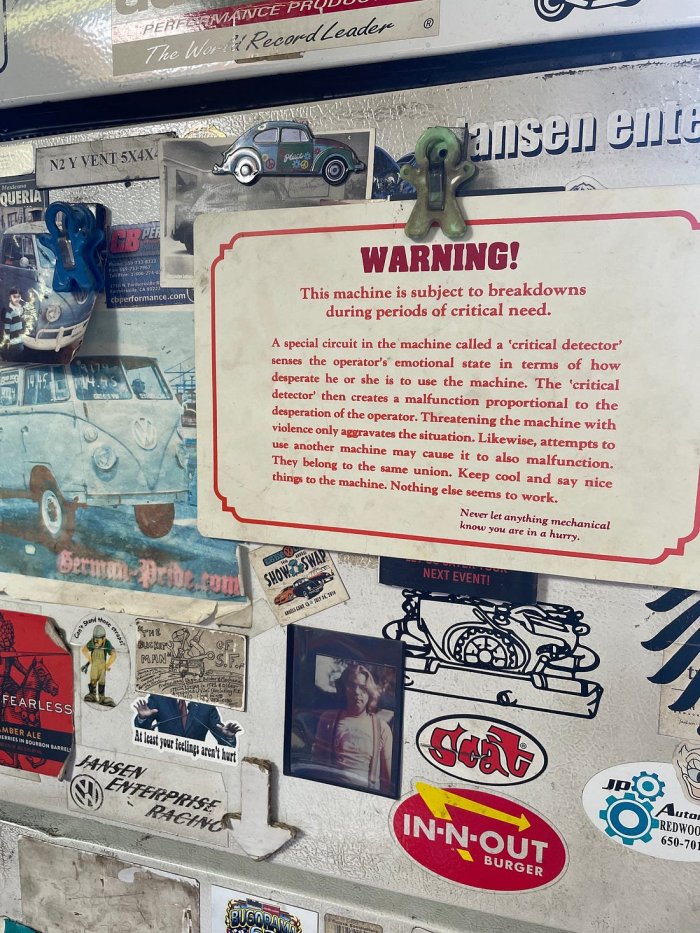
Also, the poster in this image from the essay is just perfect:
Nick Catoggio:
Firing a capable officer like Randy George is bad. Firing him because he didn’t show proper respect for Kid Rock is so unbearably humiliating for the United States that I feel it in my chest.
“Shameful” isn’t the right word, as shame implies a sense of guilt over some serious offense for which you feel directly or indirectly responsible—and, to be sure, the Trump administration routinely acts in ways that fit that bill. The George episode isn’t so much shameful as it is pathetic. It betrays a bratty juvenile fatuousness that’s only possible in political leaders who fundamentally don’t grasp, or actively disdain, the concept of dignity.