
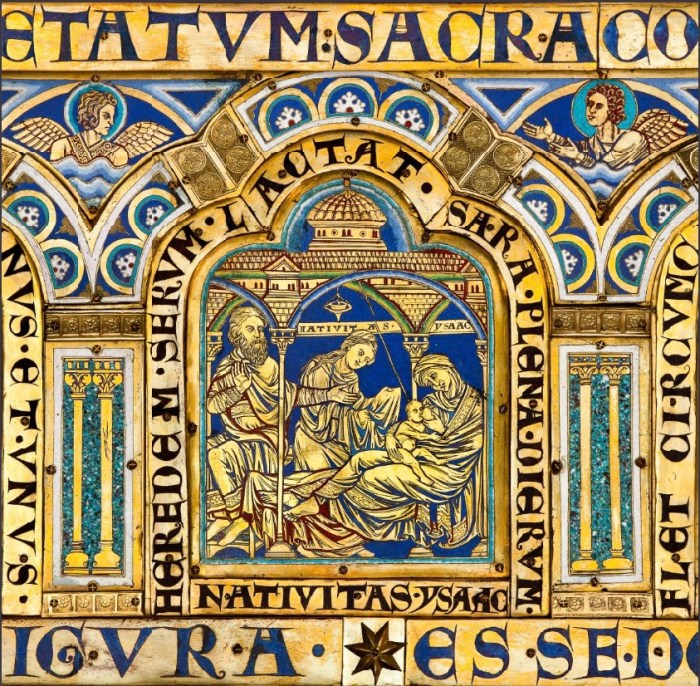
Nicholas of Verdun, The Birth of Isaac, from the Verdun Altar, c.1181
Abraham and Sarah seem doomed to laughter. Abraham laughs at the foolish idea that God would give him offspring from his wizened and childless wife Sarah, and tries to convince God to settle more reasonably on Ishmael instead (Genesis 17:17–18). Sarah herself laughs at the idea that she would bear her husband a son, but quickly dissembles the deed, terrified that she has offended the angel of the Lord (18:12–15).
Yet, when Nicholas of Verdun represented the birth of his and his wife’s child in the monumental twelfth-century Verdun Altar, he re-imagined laughter as a blessing, the sign of God’s fidelity to his covenant.
On the right lies Sarah, whose wrinkles witness to the truth of the inscription’s words that she is ‘full of days’ (plena dierum). On the left, Abraham sits enthroned, extending his hand in a gesture of paternal authority. But between the two of them, nearly unnoticed, a lamp dangles from the ceiling. It recalls the ‘smoking fire pot’ and ‘flaming torch’ that once signalled the Lord’s ratification of the covenant with Abraham (Genesis 15:7–21). The cord from which the lamp hangs cuts through the scene, visually tying together the father, the nursing child, and the womb from which he sprang. The divine promises once cryptically symbolized by dark visions in the night have been unveiled to human sight at last: the beginning of the fulfilment of the covenant is Isaac.
Small wonder, then, that Sarah’s first words since denying her laughter are a praise of God’s laughter: ‘And Sarah said, “God has made laughter for me”’ (Genesis 21:6). In Nicholas’ image, Abraham and Sarah’s faces show no outward merriment because their laughter has outstripped the limits of their own bodies and become a person: Isaac. His name means ‘he laughs’, which Sarah understands first as a reference to God; the Lord is the one who laughs, and his laughter becomes her laughter.
Sarah the new mother laughs, not with her old scepticism, but with the new life she has received from God. Sarah laughs in the birth of Isaac because she is bound now in her heart and her very flesh to the covenant with God. God laughs, and his laughter has become a covenant that will not pass away, which keeps watch over his people like a pillar of fire in the darkness.