
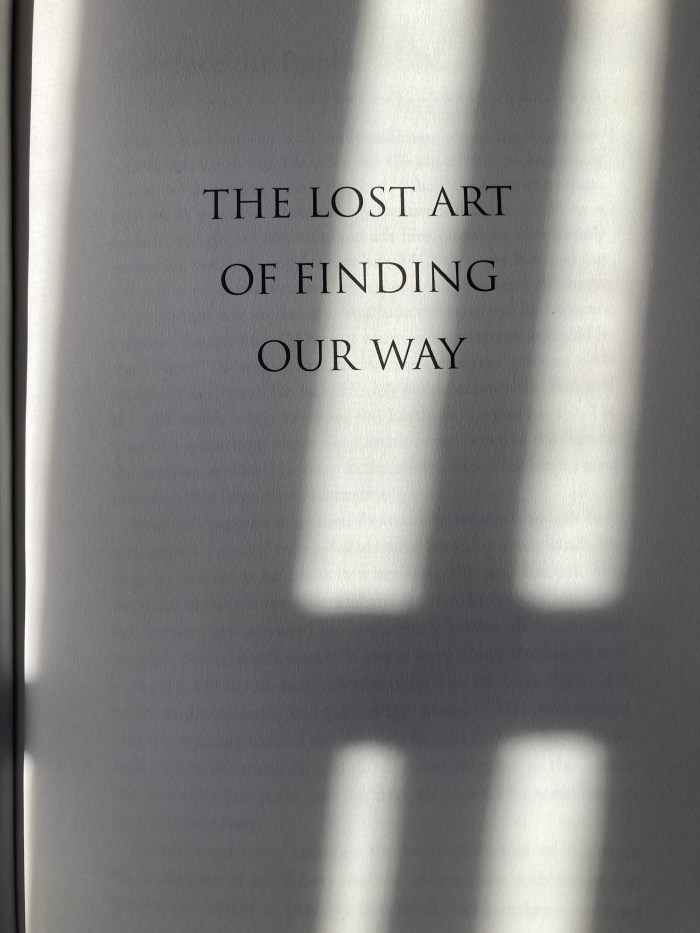
A year or two ago, I picked up John Edward Huth’s The Lost Art of Finding Our Way at the local used bookstore. It was one of those books that was entirely unknown to me but just called my name as soon as I saw it. (Christopher Alexander’s A Timeless Way of Building was like that, too. I’ve since discovered that Alexander is quite and unsurprisingly well known, though why our local not-used bookstore always has a copy of his A Timesless Way and not his much more popular A Pattern Language is a mystery.) Then it became one of many books that stares at me from the shelf asking, “How about now?”
My ability to commit to any serious reading is lower right now than it has ever been by far, but we’ll see how it goes.
Here’s Huth in the opening page:
Only a few years ago you would have sworn the commuter next to you was crazy. He talks into the air, as if to an imaginary friend, while playing with a tiny box he holds in front of his face. His whole world is a bubble two feet around his head. If, by a miracle, you get his attention and ask him questions, he can only answer by manipulating his tiny box. He checks the box and can tell you tomorrow’s weather, which way is north, and the name of that bright star in the sky. You hide the box, and he becomes helpless. You ask him, “Why is it warm in the summer and cold in the winter?” By way of explanation, the commuter gestures with his hands in front of his face. His left hand becomes the Sun and his right index finger becomes the Earth as it orbits his fist. He mumbles something about the Earth’s being closer to the Sun in the summer and farther away in the winter. His voice has a rising inflection that begs your affirmation.
Now let’s suppose it is three thousand years ago and you have transported yourself into a fisherman’s boat, far from land. He sings to himself as he hauls in a net from the sea. You ask him questions about the weather and the sky; he thinks you are crazy but humors you anyway. He confidently rattles off tomorrow’s weather, points north, and tells you a story about the bright star in the sky. He has no magic box to hide. You ask him, “Why is it warm in the summer and cold in the winter?” His outstretched arm traces an arc toward the sky, and he says that the Sun takes a high path in the summer, and the days are long; but in the winter the Sun has a low path, and the days are short. His voice has no hint of uncertainty.
Whom would you consider the more primitive of the two: the commuter or the fisherman?
Of course I love this. It’s practically something of an old saw by now, but the book was published in 2013. He wasn’t waiting for The Cell Phone Studies to prove his point.
He also isn’t actually writing about cell phones (or: cell “phones”) and lower-than-primitive moderns, but about the cultural history of navigation, “weaving together astronomy, meteorology, oceanography, and ethnography,” to quote the back of the book.
But still, or better, this is some wonderfully antidotal shit. I don’t recall if I’ve ever said much about a little back-of-the-napkin theory of mine (I touched on it here), but I believe — or hope, at least — that the excitement of being out in the middle of nowhere — or even out in town! — without any device “connecting” you to some perceived hub of human activity or knowledge or safety, will be rediscovered as its own dopamine rich, morally and psychologically sound reward. No internet, no electricity; just your five senses in a body as a soul in the world.
Huth gives me hope that, as low as we have set the bar, it could still be true:
As information technology has grown, our ability to perceive and think independently without help from devices may be compromised to the point where we, not our forebears, are the primitive ones. Long before the advent of the Global Positioning System (GPS), our distant ancestors traveled vast distances using what seem to us to be primitive technologies. In many cases explanations for the effectiveness of their systems only arose in the twentieth century; some remain a mystery. Systems of navigation developed by different cultures may not have been based on an understanding of science as we conceive it today, but they made sense, and they worked. While the device-addicted commuter may seem oblivious to and clueless about his surroundings, his ancestors proved that humans can absorb exceedingly subtle environmental clues to find their way. […]
By piecing together our knowledge of cultures of navigation, we can begin to appreciate a kinship we all share in the very human art of way-finding. … I will try to convey these techniques to you in this book, but there is no substitute for leaving the bubble and experiencing the Sun, the stars, the wind, and the waves.
Much like the rediscoverable good leisure I talked about in the link above, it’s there — eminently, imminently, infinitely discoverable and waiting.