The actual end of the 20th century as the “good old days” came for theology as for everything else with the fateful year of 1914. Accidentally or not, a significant event took place during that very year. Ernst Troeltsch, the well-known professor of systematic theology and the leader of the then most modern school, gave up his chair in theology for one in philosophy. One day in early August 1914 stands out in my personal memory as a black day. Ninety-three German intellectuals impressed public opinion by their proclamation in support of the war policy of Wilhelm II and his counselors. Among these intellectuals I discovered to my horror almost all of my theological teachers whom I had greatly venerated. In despair over what this indicated about the signs of the time I suddenly realized that I could not any longer follow either their ethics and dogmatics or their understanding of the Bible and of history. For me at least, 20th-century theology no longer held any future. For many, if not for most people, this theology did not become again what it had been, once the waters of the flood descending upon us at that time had somewhat receded. Everything has its time. Evangelical theology in the true spirit and style of the 19th century continued to exist and some vestiges still remain. But in its former wholeness it is a cause which today is significantly represented by only a few. This is not to say that we do not owe it our most serious attention for our own sake and for the sake of the future. But it remains true that the history of this theology had its beginnings, its various peaks, and then also its end.

so we got that going for us…
Prediction markets have not covered themselves in glory as the US and its allies kick off a war in Iran. Kalshi has had to reimburse trading fees to customers who hoped their bets on “Ali Khamenei out as Supreme Leader” would pay out in the event of his death, which would have unequivocally made the wager an assassination market. While Kalshi does state in their fine print that markets like this have carveouts for death to avoid being classed as assassination markets, the lack of clarity on the main betting page and Kalshi’s enthusiastic social media promotion of this specific event contract left many customers angry.24Over on Polymarket, the offshore prediction market that the CFTC is in the process of welcoming back to the country, there were no such barriers to traders’ fun. One trader named “Magamyman” made half a million bucks on the bet and other markets related to US and Israeli military strikes on the country, and placed his $87,000 in wagers over an hour before news of military action became public.
… Senator Chris Murphy (D-CT) vowed to introduce legislation to restrict prediction markets, issuing a statement that he believed it was “very likely — probable even” that people close to Trump who had advance notice of the strikes profited from placing bets. Expressing fears that such markets would increase corruption risk and result in “people inside the Situation Room who are making decisions not based on what’s good for national security, not on whether or not we should send our young men and women overseas to die, but based on whether or not they make money off of war.”
Separately, California’s Democratic Representative Mike Levin and Senator Adam Schiff have introduced the “Death Bets Act”, the name of which alone sums up the absolute dystopia we’re living in at the current moment. […]
But hey, fear not: the death-and-destruction betting platform Polymarket has teamed up with the panopticon-for-hire Palantir in a cursed partnership they promise will ensure fairness in the sports prediction markets Polymarket is bringing to the US. So that’s a relief.
“long life distilled into a burning drop”
My dear Barlow,
I am having the same aches and pains. We are the same age, after all. But it is a mistake to think that God merely sympathizes with us, God who “passed through every stage of life, restoring to all communion with God.” It is true that Christ died long before our old age, that he never faced senescence. And yet… was he not arthritic in some way on the cross? Those hands on the Isenheim altarpiece… And even the plague sores there, which after all he never actually suffered on his body—except that in one sense he did.
Perhaps we are no older than him; perhaps he aged the first part of a human lifespan in thirty years, the middle part in three years, and the last part in three days or even three hours. His features can be found in the faces of the five- and the twenty-five-year-old, surely, but also of the seventy-five-year-old; also of St. Adam in his 930th year, meditating on his deathbed upon the fruit of his youth.
“No young man believes that he shall ever die,” wrote Hazlitt in 1827, a little more than six years after Keats was no more. “Death, old age, are words without a meaning, that pass by us like the idle air which we regard not.” How otherwise it was for Keats, who had seen and endured plenty of death when he petitioned in Sleep and Poetry, the capstone of his debut volume, “Oh, for ten years, that I may overwhelm / Myself in poesy” (pp. 96-97). This was written in late 1816, published the next spring. Not granted even half this span, he still achieved a remarkably full poetic life, seeming in brief years to “write old” — so Elizabeth Barrett Browning measures the amazing intensity:
By Keats’s soul, the man who never stepped
In gradual progress like another man,
But, turning grandly on his central self,
Ensphered himself in twenty perfect years
And died, not young, – (the life of a long life
Distilled to a mere drop, falling like a tear
Upon the world’s cold cheek to make it burn
For ever;) by that strong excepted soul,
I count it strange, and hard to understand,
That nearly all young poets should write old.Long life distilled into a burning drop is a perfect conceptual biography, beautifully figured by the embrace of parentheses.
But the Serbo-Byzantine frescoes are unquestionably more naturalistic and far more literary. In looking at some of these at Neresi there came back to me the phrase of Bourget, “la végétation touffue de King Lear,” they are so packed with ideas. One presents in another form the theme treated by the painter of the fresco in the little monastery in the gorge; it shows the terribly explicit death of Christ’s body, Joseph of Arimathea is climbing a ladder to take Christ down from the Cross, and his feet as they grip the rungs are the feet of a living man, while Christ’s fect are utterly dead. Another shows an elderly woman lifting a beautiful astonished face at the spectacle of the raising of Lazarus: it pays homage to the ungrudging heart, it declares that a miracle consists of more than a wonderful act, it requires people who are willing to admit that something wonderful has been done. Another Shows an Apostle hastening to the Eucharist, with the speed of a wish.
But there is another which is extraordinary beyond belief because not only does it look like a painting by Blake, it actually illustrates a poem by Blake. It shows the infant Christ being washed by a woman who is a fury. Of that same child, of that same woman, Blake wrote:
And if the Babe is born a boy
He’s given to a Woman Old
Who nails him down upon a rock,
Catches his shrieks in cups of gold.She binds iron thorns around his head,
She pierces both his hands and feet,
She cuts his heart out at his side,
To make it feel both cold and heat.Her fingers number every nerve,
Just as a miser counts his gold;
She lives upon his shrieks and cries,
And she grows young as he grows old.It is all in the fresco at Neresi. The fingers number every nerve of the infant Christ, just as a miser counts his gold; that is spoken of by the tense, tough muscles of her arms, the compulsive fingers, terrible, seen through the waters of the bath as marine tentacles. She is catching his shrieks in cups of gold; that is to say, she is looking down with awe on what she is so freely handling. She is binding iron around his head, she is piercing both his hands and feet, she is cutting his heart out at his side, because she is naming him in her mind the Christ, to whom these things are to happen. It is not possible that that verse and this fresco should not have been the work of the same mind. Yet the verse was written one hundred and fifty years ago by a home-keeping Cockney and the fresco was painted eight hundred years ago by an unknown Slav. Two things which should be together, which illumine cach other, had strayed far apart, only to be joined for a minute or two at rare intervals in the attention of casual visitors. It was to counter this rangy quality in the universe that the little monk had desired to maintain contact between his devotions and their objects. His shining eyes showed a faith that, bidden, would have happily accepted more exacting tasks.
take your @#$%&! hat off
Hiroshi Miyamura was the son of Japanese immigrants who owned a diner in New Mexico, and he did his parents’ new country proud. Trump is the son of a mobbed-up Queens slumlord and the grandson of a Yukon whorehouse operator who has, in a perverse feat, managed to tarnish the already stained family name he inherited. Trump is no Hiroshi Miyamura: In his own infamously ungrateful words, he prefers the ones who didn’t get captured. Trump’s military record, if there were one, would convey only the information that his chiseling bigot of a father paid a crooked doctor to invent a phony diagnosis of “bone spurs” to keep the sniveling little coward out of service during the Vietnam War—and that those bone spurs magically disappeared, without treatment, vanishing alongside the danger that supposed tough guy Donald Trump might face the burden of service to his country in wartime.
That sort of contemptible shirker has no business saluting dead American soldiers, whatever his station in life. But if the casualties of Trump’s illegal war in Iran must endure the indignity of being saluted by such a lowlife as he, the least the commander in chief could do would be to comport himself like a man of almost 80 years rather than a boy of 8 years and take his @#$%&! baseball cap off.
Oh, he’s not done.
Trump is both stupid and ignorant—those are not the same things—and maybe nobody ever told him that it is bad manners to wear a hat on such an occasion. We live in a world in which vulgarians far less consequential than the president of these United States insist on wearing hats in restaurants, in church, and in other settings where men’s headwear ought properly to be removed.
Or maybe he was just having a bad hair day—which, in Trump’s case, is another way of saying “a day.” Trump still has the dumbest hair in America, which is a hell of a thing to write about a man standing next to Pete Hegseth, the Brylcreem-addicted grandstanding dipsomaniac peacock who is so committed to the principle that our military must stop waging war like a bunch of teenaged girls that he apparently has decided to wage war against teenaged girls in Iran, though the supposedly fearless and plain-speaking Secretary of Don’t You Dare Call It “War” apparently lacks the moral courage to take any responsibility for what his Department of Don’t You Dare Call It “War” has done.
[…]
Elizabeth Marvel’s short but winning turn as a grown-up Mattie at the end of the 2010 version of True Grit ends with her learning of Rooster’s death from Cole Younger, who stands to deliver the sad news, and the infamous outlaw Frank James, who remains conspicuously seated. Mattie nods and, as she withdraws, turns to Frank James, spitting: “Keep your seat, trash.” Some people need that scene explained to them, and some don’t.
Most of us will never be asked to serve our country in the way those dead Americans transiting through Dover Air Base did. Donald Trump was asked. He refused, and did so in a particularly dishonorable way—and then spent much of his life joking about how he had gotten one over on those poor dumb rubes who actually went to Vietnam to get killed and maimed. The least he could do is demonstrate some basic courtesy in the presence of the bodies of those Americans who had the honor and sense of duty to do what Trump would not.
Seriously: Take your @#$%&! hat off.
“like poppies among the corn”
‘Be ye perfect even as your Father who is in heaven’ Love in the same way as the sun gives light. Love has to be brought back to ourselves in order that it may be shed on all things. God alone loves all things and he only loves himself.
To love in God is far more difficult than we think.
[…]We have to endure the discordance between imagination and fact. It is better to say ‘I am suffering’ than ‘this landscape is ugly’.
______
This morning I sat in bed and drank fresh coffee from a handmade mug and read a Plough essay on La Tour’s Adoration of the Shepherds. Then, with the empty mug on the (prisoner-crafted) nightstand, I ate scrambled eggs and pancakes while the sun shined warmly on my feet through brand new, argon-insulated windows. And all this with my week-old son sleeping on my lap, as peacefully as any baby in history has slept — and that amazingly no less for the occasional, joyful-but-less-than-peaceful incursions from my two-year-old son.
Also this morning, the two-year-old latched onto the phrase “life is good.”
______
I am aware of a shooting in Virginia and an attack on a synagogue in Michigan yesterday. I am aware that my country — Weil again is first to mind whenever I say that — my country among many horrible things of late and not-so-late, made feckless promises to the more than 30,000 murdered Iranian protesters in January, only to itself — ourselves — butcher another 165 Iranians (mostly children) at the very start of our apparent attempt to keep that promise.
(Don’t click this link unless you really want to know what we do.)
.jpg)
It wasn’t just that man, or those people; we did it — we did it.
______
“I’m so sorry, Ellen, so sorry.”
“You don’t need to apologize, Mr. Theo. It’s not your fault.”
“Maybe not. But maybe yes. Ellen, the older I get, the more convinced I am that every hurt the world has ever known is somehow the fault of every person who ever lived. Maybe not directly and never entirely, but somehow, I fear, we own all of the world’s hurts together.”
…
“And then, out of nowhere, we both started sobbing. All of a sudden, I think we both had visions of what we had lived through together. God, it was horrible.” Tony closed his eyes and groaned.…
“And it was like, when we saw each other, we were both think-ing, did we really live through that? Were we really there? And I think we both hurt for each other. Then I grabbed him, and we held on to each other, and I swear it felt like we were begging for forgiveness or something, not just for being soldiers in that war but also for being part of a world that can do such godawful things.”
______
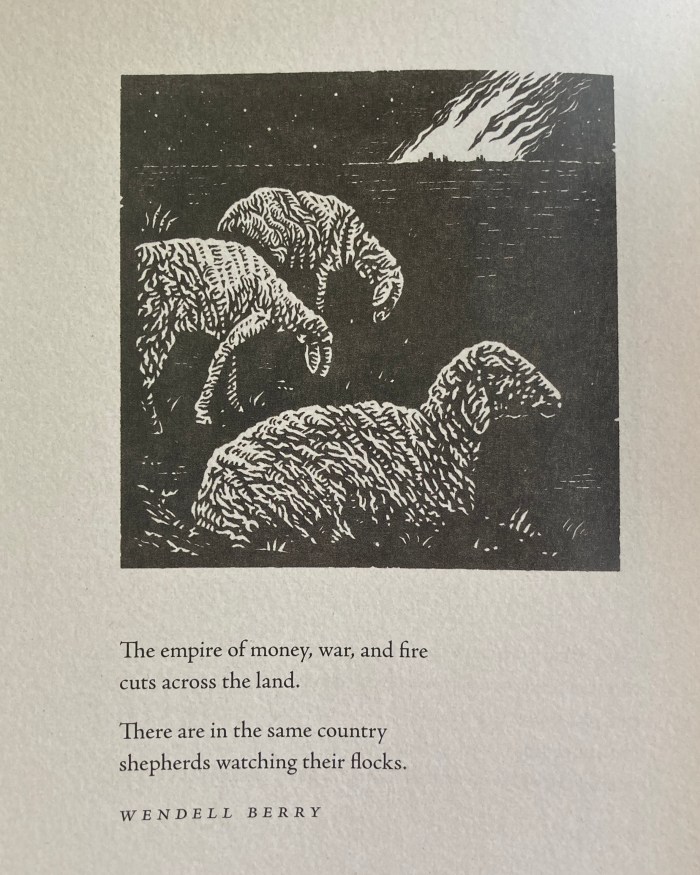
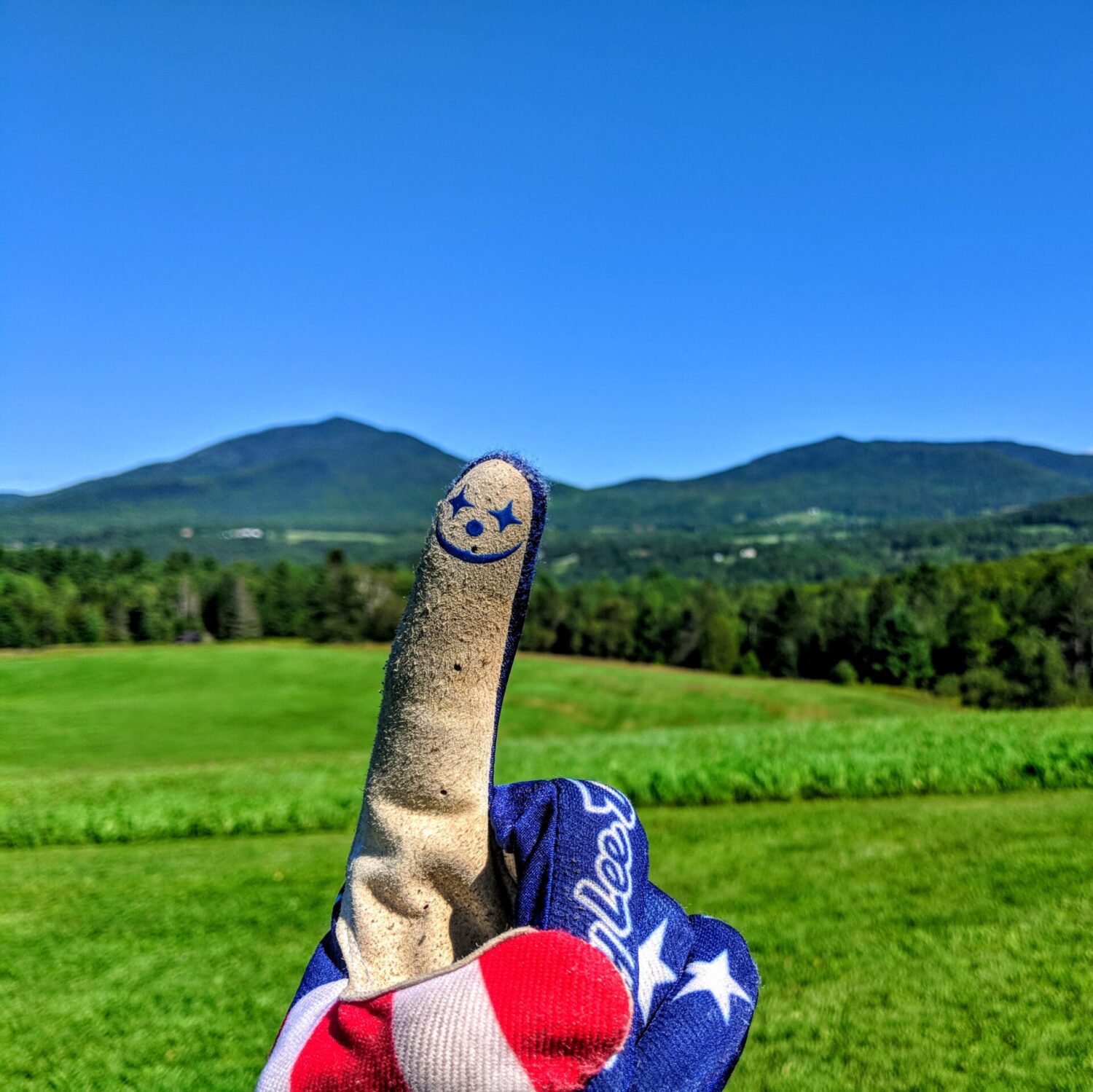
Of course, we need not, and should not, cease our fun or recreation and “learning in wartime,” but — at the risk of undesirably and unintentionally offending some close to me — wouldn’t it be wonderful if every last one of us refused to play golf.
______
The other day I read Peter Mommsen’s introduction to the same issue of Plough.
The Book of Wisdom urges us to see the world as freighted with meaning. This dawn, this forest, this deer, this dog, this heron: each is a poem about God. […]
As Wordsworth put it in the title of his poem, our experiences of beauty come to us as “intimations of immortality.”
But even the beautiful natural landscape is not all peace and light. Where Peter of Damascus looked at the world and saw “order,” “proportion,” and “harmony,” the modern mind wonders how to reckon with the underlying violence: Darwinian competition for survival, Tennyson’s “nature red in tooth and claw.” The maple woods may seem lovely, but any given tree may be in competition against the rest for access to nutrients and sunlight. The noble-looking deer likely harbors hideous parasites and, come winter, faces a one in three chance of death by disease, starvation, or coyote. When the largemouth bass breed next spring, 99.8 percent of their hatchlings will perish before adulthood, many cannibalized by their own siblings. […]
Any beauty that excludes humankind’s imperfection and vulnerability is prone to becoming subhuman. And even the wholesome beauty of nature is only a partial truth in a world where children starve in war zones or are trafficked to abusers.
______
Also the other day, I was flipping through Rebecca West’s Black Lamb and Grey Falcon and landed on a chapter in Macedonia. It is 1937 and she is visiting a monastery outside Tetovo, in a village called the Sorrowing Women. The Abbot of the monastery is described as “one of the most completely created human beings I have ever met.”
I noticed all this through a haze of pleasure caused by the man’s immense animal vigour, and his twinkling charm, which was effective even when it was realized to be voluntary. His disingenuousness failed to repel for the same reason that made it transparently obvious. It was dictated by some active but superficial force in the foreground of his mind; but a fundamental sincerity, of the inflexible though not consciously moral sort found in true artists, watched what he was doing with absolute justice. All his intellectual processes were of a hard ability, beautiful to watch, but it was surprising to find that they were sometimes frustrated by his lack of knowledge. … His life had been spent in a continuous struggle for power, which had given him no time to pursue knowledge that was not of immediate use to him; and indeed such a pursuit would have been enormously difficult in his deprived and harried environment. But his poetic gift of intuitive apprehension, which was great, warned him how much there was to be known, and how intoxicating it would be to experience such contact with reality; and that perhaps accounted for his restlessness, his ambiguity, the perpetual splitting and refusion of his personality.
The descriptions of the Abbot that West offers are written with that same ambiguity and splitting — they are both very unsympathetic and very sympathetic. And this seems to be intentional, or at least unavoidable.
Dragutin and I alike would have been amazed if his courage or his cunning had failed, and in time of danger we would run into the palm of his hand. We knew quite well that he cared for nothing but an idea, and that his heart regarded his own ambition without approval. If his ways were tortuous, those of nature are not less so, as the geneticist and the chemist know them. To reject this man was to reject life, though to accept him wholly would have been to doom life to be what it is for ever.
______
Leaving the village, West offers this description — a passage about as representative of the book as any you might find:
The valley broadened to wide Biblical plains, stretching to distant mountains that were of no colour and all colours. The ground we looked on was sodden with blood and tears, for we were drawing near the Albanian frontier, and there are few parts of the world that have known more politically induced sorrow. Here the Turks fostered disorder, lest their subjects unite against them, and here after the war Albanians and Bulgarians fought against incorporation in Yugoslavia and had to be subdued by force. There was no help for it, since the Yugoslavs had to hold this district if they were to defend themselves against Italy. But to say that the conflict was inevitable is not to deny that it was hideous. This land, by a familiar irony, is astonishing in its beauty. Not even Greece is lovelier than this corner of Macedonia. Now a violet storm massed low on the far Albanian mountains, and on the green plains at their feet walked light, light that was pouring through a hole in the dark sky, but not as a ray, as a cloud, not bounded yet definite, a formless being which was very present, as like God as anything we may see. It is a land made for the exhibition of mysteries, this Macedonia. Here is made manifest a chief element in human disappointment, the discrepancy between our lives and their framework. The earth is a stage exquisitely set; too often destiny will not let us act on it, or forces us to perform a hideous melodrama. Our amazement is set forth here in Macedonia in these tragically sculptured mountains and forests, in the white village called the Sorrowing Women, in the maintained light that walked as God on the fields where hatreds are like poppies among the corn.
______
PERHAPS . . .
for the loneliness of an authorPerhaps these thoughts of ours
will never find an audience
Perhaps the mistaken road
will end in a mistake
Perhaps the lamps we light one at a time
will be blown out, one at a time
Perhaps the candles of our lives will gutter out
without lighting a fire to warm usPerhaps when all the tears have been shed
the earth will be more fertile
Perhaps when we sing praises to the sun
the sun will praise us in return
Perhaps these heavy burdens
will strengthen our philosophy
Perhaps when we weep for those in misery
we must be silent about miseries of our ownPerhaps
Because of our irresistible mission
We have no choice— Shu Ting
Translated from the Chinese by Carolyn Kizer
______
Today is now almost gone by. I’m taking an hour at the pub, sitting at the bar nursing a beer and a dark mood alongside the largest joys of my entire life.
The air outside that I’ll walk home in is cold again and more snow is just a few hours away.
“What else can be?” my son likes to say when he’s looking for something.
______
From Pete McElroy’s “A House of Random Cards”:
And I think: I will fail at this;
I will fail as husband and father
and brother- and son-in-law,
as comforter and counselor, at everything
except perhaps the office of historian, who notes
the silent weeping of a soul
in torment and the hard embrace
and the wordless joyful oblivion.And now, late at night, alone
by the fire, a book of verse open but
face-down beside it,
and outside the soft white powder
of recent snow and frigid air catching
and holding the diffused light
of a distant cold indifferent winter moon,I think my heart will crack—
not for death, which is certain
and now imminent, but for life and the living:
for a daughter and a son who today
reminded me there are proximate worlds that are
worlds apart and that for my children’s sakes
and for their mother’s and for others’
and even for my own I must occupy them all
at once forever or fail like a hand of random cards
or like a pair of lungs.
______
I do think my heart will crack.
What else can be?
Hartmut Rosa:
[A]stonishingly, political actors feel (or at least present themselves as being) utterly powerless. From Margaret “There Is No Alternative” Thatcher to Gerhard “Basta!” Schröder, the belief has set in among political leaders that the basic parameters of political action are defined by markets, processes of globalization, and the logic of competition. They themselves have no control over these processes; there is no alternative. One can only act “wrongly,” fall behind in global competition, and thus squander one’s opportunities for future control. […]
In the end modernity’s program of making the world controllable threatens to produce a new, radical form of uncontrollability, one that is categorically different from and worse than the original, because we are incapable of experiencing self-efficacy or of establishing a responsive relationship of adaptive transformation when confronted with it.
Trump Sons Merge Golf Firm With Powerus to Target $1.1B Pentagon Drone Contracts
The rapid expansion of the United States defence-tech sector has reached a controversial new junction, as Eric Trump and Donald Trump Jr. confirm their latest venture into the lucrative world of unmanned aerial systems.
Through a strategic reverse merger between the Trump-backed golf-course operator Aureus Greenway Holdings and the burgeoning Florida-based manufacturer Powerus, the president’s sons are positioning themselves to capitalise on a massive shift in military procurement.
______
Trump sons-backed Aureus to merge with drone maker Powerus
Aureus Greenway (AGH.O), opens new tab, a golf club company backed by the sons of U.S. President Donald Trump, said on Monday it would merge with Powerus in a deal designed to take the drone technology company public.
The transaction is the latest in Eric and Donald Trump Jr.’s growing investments in the drone sector, following last month’s $1.5 billion tie-up between Israeli drone maker XTEND and Florida-based JFB Construction (JFB.O)
______

The U.S. military is using the most advanced AI it has ever used in warfare, with Anthropic’s Claude AI reported to be assessing intelligence, identifying targets, and simulating battle scenarios, even as the Pentagon said it would terminate its contract with the company over a disagreement about its use. […]
The biggest role that AI now has in U.S. military operations in Iran, as well as Venezuela, is in decision-support systems, or AI-powered targeting systems, Feldstein said. AI can process reams of surveillance information, satellite imagery, and other intelligence, and provide insights for potential strikes. The AI systems offer speed, scale, and cost-efficiency, and “are a game-changer,” he said. […]
AI has long been used to analyze satellite imagery and guide missile-defense systems, but the use of chatbots such as Claude in decision-support systems is new. There is no clarity yet on how accurate these systems are and how they make decisions. In a recent study, AI models from OpenAI, Anthropic, and Google opted to use nuclear weapons in simulated war games in 95% of cases. Lavender, an AI-powered database used by Israel to analyze surveillance data and identify potential targets in Gaza, was wrong at least 10% of the time, resulting in thousands of civilian casualties.
“Murderers without malice” was an understatement.