Humans have stark and urgent material needs, and they’re right in front of us. Why should most people examine and scrub each situation down to its philosophical foundations, looking for consistent rules?
The ideas do matter. A strong design education should have philosophical and historical training at its non-negotiable core. But instead of a linear model where we assume that ideas always manifest themselves downstream in tangible design, we might take seriously that the causality runs both ways—that design with a demonstrated commitment to sacred humanness is itself a form of argument. Both neuroscience and environmental psychology show that our behavior is shaped in part by our designed surroundings. So we might set out to start with design—with a come-and-see invitation to the designed spaces and places where humans thrive. We might put forth a more sturdy anthropology by example, an irresistibly beautiful and consistent life ethic—an ethic that comes alive in the attentive structural details and material choices of our spaces and in the activities they envelop—rather than waiting around for a proper rationale to always lead the way. We might build the kinds of settings that signal the strong worth of the people inside them.
Leopold Staff:
Foundations
I built on the sand And it tumbled down, I built on the rock And it tumbled down. Now when I build, I shall begin with smoke from the chimney.
Translated from the Polish by Czeslaw Milosz
(Milosz said that this is a poem of “naked faith,” written in the immediate ashes of World War II. “What was left was to do what a child does, who when trying to draw a house often starts with the smoke from the chimney, then draws a chimney, and then the rest.”
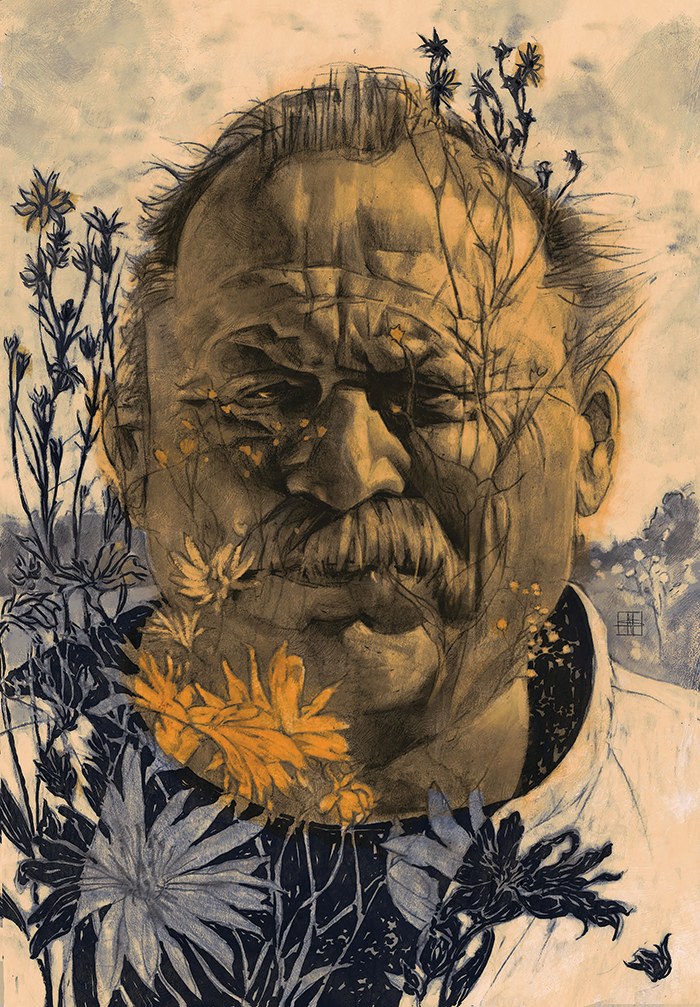
Nate Sweitzer, “The Mozart of the Prairies” (source)
Today, I am told, is the 10th anniversary of the death of Jim Harrison. The Substack The Poetic Outlaws has up a moving, and haunting, tribute to the man.
Though I have not been a wide reader of Harrison, I claim deep admiration. Braided Creek with Ted Kooser was one of the most instantly and naturally loveable books of poetry I’ve ever held.
Inspired this morning, and isolated to an upper corner of the house nursing the end of some flu-like thing, I picked up his splendid collection Dead Man’s Float. This is the opening poem:
Where is Jim Harrison?
He fell off the cliff of a seven-inch zafu. He couldn’t get up because of his surgery. He believes in the Resurrection mostly because he was never taught how not to.
This idea of movement and the metaphor of the river, seem to be central to your work.
It’s the origin of the thinking behind The Theory and Practice of Rivers. In a life properly lived, you’re a river. You touch things lightly or deeply; you move along because life herself moves, and you can’t stop it; you can’t figure out a banal game plan applicable to all situations; you just have to go with the “beingness” of life, as Rilke would have it. In Sundog, Strang says a dam doesn’t stop a river, it just controls the flow. Technically speaking, you can’t stop one at all.
But you have to work at it, make a conscious effort so that your life flows like a river?
Antaeus magazine wanted me to write a piece for their issue about nature. I told them I couldn’t write about nature but that I’d write them a little piece about getting lost and all the profoundly good aspects of being lost—the immense fresh feeling of really being lost. I said there that my definition of magic in the human personality, in fiction and in poetry, is the ultimate level of attentiveness. Nearly everyone goes through life with the same potential perceptions and baggage, whether it’s marriage, children, education, or unhappy childhoods, whatever; and when I say attentiveness I don’t mean just to reality, but to what’s exponentially possible in reality. I don’t think, for instance, that Márquez is pushing it in One Hundred Years of Solitude—that was simply his sense of reality. The critics call this magic realism, but they don’t understand the Latin world at all. Just take a trip to Brazil. Go into the jungle and take a look around. This old Chippewa I know—he’s about seventy-five years old—said to me, “Did you know that there are people who don’t know that every tree is different from every other tree?” This amazed him. Or don’t know that a nation has a soul as well as a history, or that the ground has ghosts that stay in one area. All this is true, but why are people incapable of ascribing to the natural world the kind of mystery that they think they are somehow deserving of but have never reached? This attentiveness is your main tool in life, and in fiction, or else you’re going to be boring. As Rimbaud said, which I believed very much when I was nineteen and which now I’ve come back to, for our purposes as artists, everything we are taught is false—everything.
Here’s another from Dead Man’s Float:
The River
Yes, we’ll gather by the river, the beautiful, the beautiful river. They say it runs by the throne of God. This is where God invented fish. Wherever, but then God’s throne is as wide as the universe. If you’re attentive you’ll see the throne’s borders in the stars. We’re on this side and when you get to the other side we don’t know what will happen if anything. If nothing happens we won’t know it, I said once. Is that cynical? No, nothing is nothing, not upsetting just nothing. Then again maybe we’ll be cast at the speed of light through the universe to God’s throne. His hair is bounteous. All the 5,000 birds on earth were created there. The firstborn cranes, herons, hawks, at the back so as not to frighten the little ones. Even now they remember this divine habitat. Shall we gather at the river, this beautiful river? We’ll sing with the warblers perched on his eyelashes.
If you don’t already love the man, take four minutes to watch this PBS recap of a 2009 interview with him. He was, or is in my imagination, like a more feral Malcolm Guite.
From Harrison’s poem “Bridge”:
Most of my life was spent building a bridge out over the sea though the sea was too wide. I’m proud of the bridge hanging in the pure sea air.…
Sometimes the sea roars and howls like the animal it is, a continent wide and alive. What beauty in this darkest music over which you can hear the lightest music of human behavior, the tender connection between men and galaxies.
So I sit on the edge, wagging my feet above the abyss. Tonight the moon will be in my lap. This is my job, to study the universe from my bridge. I have the sky, the sea, the faint green streak of Canadian forest on the far shore.
I didn’t know who Jim Harrison was when he died — back then, I didn’t know that he was or that he had died. He even sat on my own shelves for years, unknown to me, unknowingly collected and collecting dust.
Today I am happy — lucky and grateful — that he was and is here.
We are, once again and inexplicably, seeing a conversation unfold about reforming the military force in our streets, with body cameras and training standing in for a moral reckoning about the kind of world we want to live in, the kind of world that is livable for more than the wealthy few. We know what such “reforms” accomplish, because we’ve seen this many times before: an armed, unaccountable force with body cameras is no less deadly or immoral than an armed, unaccountable force without. A trained secret police is still the secret police.
[…]
Body cameras promise increased surveillance with no attendant increase in accountability, while training maintains the distribution of money and resources away from care and towards cops and prisons; both reforms represent business as usual, not a remade world.
I take the heart of her point as a very good point, even if she takes it to an untenable place. In fact, that isn’t strong enough: This is very important, even if the “defund the police” direction she seems to favor in that post is the wrong one. (She does seem to me to be saying significantly more that just “abolish ICE.”)
Reform is not enough, or entirely wrongheaded, she suggests. Instead, Brown highlights André Gorz’s “non-reformist reforms.”
For Gorz, a reform is non-reformist if it both exercises the power and agency of workers acting together and foreshadows the future world in the present. That is, a non-reformist reform requires both concrete, bottoms-up action and the reflection of a different world within that action, the way a small fractal prefigures the large.
Far be it from me to knock some fun wordplay like “non-reformist reforms,” but I am skeptical that that could be a term to hang a hat on. (I could be further convinced.) And I don’t know anything about Gorz. And I am still skeptical of the extent to which Brown would take what she is calling “abolitionist demands.”
That description of non-reformist reforms, however, has potential.
Here’s Miroslav Volf, who I couldn’t help thinking of reading Brown’s post, in the closing of a 2012 piece which is included in the second edition of his book The End of Memory:
All the conditions for non-remembrance of wrongs suffered and committed will be realized only in the coming world of love, a world that, in turn, is hard to imagine as a reality with truthful and living memory of the horrors of history. And yet, this eschatological hope can shape our practice today. When the miracle of such non-remembrance happens in families, among friends, or in small communities—on those occasions, not so rare as one may think, a ray of light from the dawning world of love has illumined our lives.
Here’s Volf earlier in the book:
[I]n Jesus Christ God has promised to every human being a new horizon of possibilities — a new life into which each of us is called to grow in our own way and ultimately a new world freed from all enmity, a world of love. To be a Christian means that new possibilities are defined by that promise, not by any past experience, however devastating. If the traumatized believe the promise — if they live into the promise, even if they are tempted at first to mock it — they will, in [David] Kelsey’s words, enter a world “marked by a genuinely open future that they could not have imagined in the living death of the old world they have constructed for themselves.”
Call it what you want, but that sounds like real reform to me. That I don’t find anything this rich in the Brown or Gorz program will likely always be a problem for me. In fact, somewhere in this post is an urge, but not the time, to go down that “Why I’m still a Christian” road. Instead, I’ll settle for some overlapping Venns.
So I trust this in the hands of Volf far more than Brown, but Brown’s longing for changes that foreshadow a world “where care overcomes criminalization” is exactly right. And, my own alarms bells about some secularized postmillennialism notwithstanding, I love the way she puts it:
To put this another way: a reform maintains the old world, often under cover. While a non-reformist reform demands that we build a new world, one in which all humans and the more-than-human world can thrive.
We must take small steps towards the future we want; there is no other way. But each step must point the way toward that future, a drop of water that heralds the wave.
Our selves are not unlike what post-modern thinkers describe them to be: dispersed in all centeredness, discontinuous in all continuities, fractured notwithstanding all attempts to render ourselves coherent, and ever changing while manifestly always being self-same. And memory is at the heart of all these pulsating tensions of our vital selves.
… Superimpose on this account of personal identity a theologically informed notion of the self … Martin Luther’s famous little treatise The Freedom of the Christian reaches its peak when he concludes,
a Christian lives not in himself, but in Christ and in his neighbor. Otherwise he is not a Christian. He lives in Christ through faith, in his neighbor through love. By faith he is caught up beyond himself into God. By love he descends beneath himself into his neighbor. Yet he always remains in God and in his love.
To be a Christian means, in a sense, to be displaced. […]
Being “caught beyond” ourselves and placed “into God” is significant for Luther…. Behind his account of how God saves human beings lies his account of who human beings are. We are neither made nor unmade by what we do or by what others do to us. The heart of our identity lies not in our hands, but in God’s hands.…
… It follows that, in terms of identity, we are not fundamentally the sum of our past experiences (as we are also not fundamentally our present experiences or our future hopes added to our past experiences). Our memories, experiences, and hopes still matter; but they qualify rather then define who we are. If this is correct, the grip of the past on our identity has been broken.
The truth is that we may really have our time as given by God; our whole time, even in its character as past and passing time. But the further question arises what is meant by the fact that we were. That we were is real because primarily, beyond us and for us, God was, in His omnipotent grace and mercy, holiness and righteousness. He loved us in our time then, and because He has not ceased to do so, we are real even in that time. But this means that our past being, which accumulates with each succeeding day and hour, and which we bring behind us, stands wholly under His judgment. In this whole sphere, there is no more divine offer, summons, invitation or opportunity for us. The die has been cast. What we were, we were; with all that we did and omitted to do, all that we discovered and overlooked, all the good and evil that we did and suffered, all the beauty that we enjoyed or in our stupidity failed to notice, all the joys that we experienced or missed because we were not equal to them. Everything was exactly as it was. Nothing can be taken away from it or added to it, nothing improved upon or made worse. It was all before God, and it is still before Him in all its reality. No recollection is needed, nor can oblivion alter the fact that it is still before God and therefore as real now as it was then. Even our present, the remarkable result of our past, is not needed to establish this. We are really the persons we were in the whole duration and extent of our past, because in it we were before God, to whom we owed everything but were also responsible for everything. He it was who even then gave, withheld and took away. He it was who even then helped and encountered us. He it was who even then rewarded and punished us according to His wisdom and justice. He it was who even then knew us through and through, however much we tried to disguise or conceal ourselves. He it was who even then was greater than our heart, who could use us or find us unserviceable and yet use us otherwise than we perceived. All this past of ours stands under His judgment and sentence. As those we were, in all the unalterability in which we really were it, we are delivered up wholly into His hands, for grace or condemnation. That this is so, that we are simply in His hands and at His disposal, unable to do anything about it ourselves, is what is meant by the fact that we were. It might seem doubtful in the present and especially the future tense. For in the present and especially the future tense our personal plans, decisions and actions might seem to be a secondary and co-operative determination of our existence. But our being in time also has this tense—the past. One day, indeed, it will have only this tense. This does not mean that it is destined to perish. Because God exists, it is real even in this tense. But even the blind is surely compelled to see that in this tense it is in God’s hands. If He willed to accept it, it is accepted. If He willed to reject it, it is rejected. And He owed us nothing—we owed Him everything. What was it then? Exactly what his decision, His judgment, His verdict made it; exactly what we shall see it to have been when the book in which it stood, the book of God, is opened. No more, no less, no different. “It is God who rules.”
The best I can do to find something resembling real strategic acumen in all of this is to speculate that Trump realizes the SAVE America Act is unlikely to pass. He might not even want it to pass. What he wants is ammunition to cry “rigged!” if and when (probably when) Democrats mop the floor with Republicans this fall. “If we had passed federal voter ID like I wanted, the left never would have been able to cheat!” the president will cry.
He’s setting the table for Stop the Steal 2.0 […]
Meanwhile, because a meaningful chunk of postliberals oppose the war and are eager to claim vindication for opposing it, they won’t be as eager this time to shift blame for Republican defeat away from the president and onto Democratic cheating. With a battle brewing over the future of the post-Trump GOP, which do you think “America First” isolationists like Tucker Carlson and Marjorie Taylor Greene would rather have right-wingers believe? That Americans love Trump’s war but were foiled at the polls by a massive plot to let illegal immigrants vote?
Or that Americans hated Trump’s war and turned out en masse on Election Day to punish him for it, requiring the GOP to take a bold new Lindberghian direction on foreign policy in 2028?
Translation (mine, at least): The Republican Party has probably only just begun its downward spiral. That Lindberghian isolationist direction, the noise of which is growing fast, has nothing to do with “buying local.” Whatever Trump is, Vance and Carlson, etc. are worse. If you’re tired of opposing the GOP as it is now, buckle up.
I’m not sure I know many people who use hand tools for exclusively pragmatic reasons. The decision to shape wood with finely honed edge tools is almost always a decision to exercise agency, to purposefully involve our very selves in our work. The world outside smugly sneers at the nostalgia. “Making things should be easy,” they tell us. Why bother learning manual skills or sweating fine-grained joinery details when you can play with composites and 3D printing? In this new wave of “craft,” our designs can be untethered from the constraints of wood grain or traditional construction methods. We are no longer hindered by our lack of skills or underdeveloped sense of design. There’s an app for that, and if we want things to run smoothly, we’d best just get out of the way.
This is simply another way of illustrating the fact that outsourcing is the obsession of modernity.
[…]
Craft is about dexterity, yes, but it is a dexterity that pays attention. This is to say that a true craftsman takes care.
By contrast, technology is not an apparatus of care. Indeed, being nothing more than belts and gears, ones and zeroes, technologies cannot care. Only a person can care. Woodshop machinery, for instance, is unconcerned with grain direction or the most attractive orientation of the lumber – that is the purview of the artisan. But the logic of the development of technology is to ever more distance the artisan from the work.
[…]
Let us be clear on this point: Writing is a craft. And if writing is a craft, it follows that authentic wordcraft is something that could only come from a writer – someone who has something to say. When we instead have nothing to say, yet we believe that something should be said, we embezzle the words from a chatbot. We publish the drivel, and no matter how readable it might be, no warm-blooded soul could be moved by it. But it’s not because there is no logic to the string of words (there often is), nor because it’s clunky or awkward in its phrasing (it’s getting better all the time), but because we have conflated our desire for having something to say with actually having something to say.
But the prompt is not the craft.
So much more in that essay worth quoting. Thanks to Jeremy Abel for alerting me to it.
Wars have always targeted the infrastructure of their age. Medieval armies burned granaries. Modern ones target communications and energy installations.
The Iranian regime has been true to historical form. Under attack by the U.S. and Israel, it has been striking back at the oil and gas infrastructure of its Gulf neighbors, and has closed the Strait of Hormuz — the choke point through which a fifth of the world’s oil supply normally flows. The energy markets understand this kind of damage; they have priced it in for decades.
But Iran has clearly read the new playbook.
When its drones struck three Amazon Web Services data centers in the United Arab Emirates and Bahrain on March 1 — the first confirmed military attack on a hyperscale cloud provider in history — Tehran was not lashing out blindly. It was making a calculated statement about the 21st century’s most valuable infrastructure.
The message was simple, and it landed: The cloud has an address, and that address can burn.
[…]
Iran’s drones didn’t just strike a set of server farms, they struck an assumption — the foundational premise on which the U.S. and Silicon Valley had constructed one of the most ambitious technology partnerships in history.
That assumption was stability. And Washington is the one that shattered it.
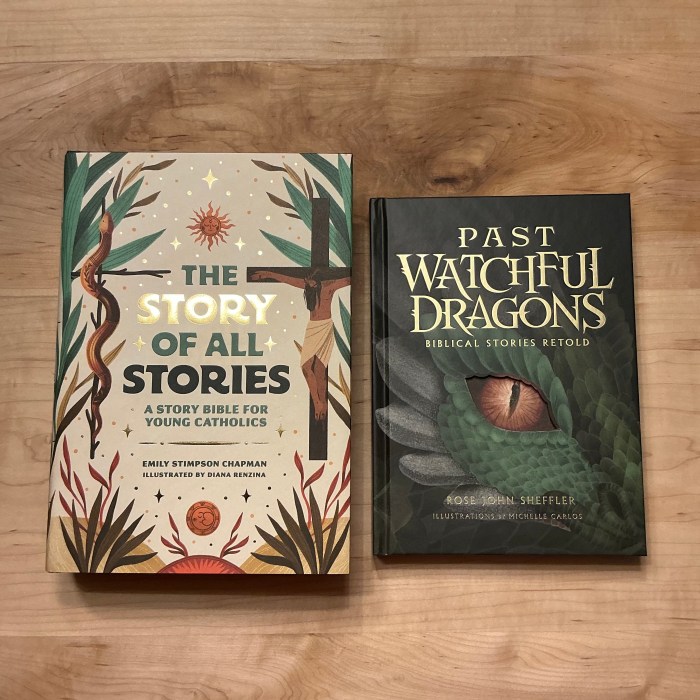
Along with McCullough’s The Body of This Death, I acquiesced to the seller’s suggestion that I purchase these conveniently discounted items. I cannot vouch for them yet, but I’m hoping they can live up to some Eugene Peterson-sown hopes.
Here’s Peterson in the introduction to Reversed Thunder:
Every Monday I leave the routines of my daily work and hike along the streams and through the forests of Maryland. The first hours of that walk are uneventful: I am tired, sluggish, inattentive. Then birdsong begins to penetrate my senses, and the play of light on oak leaves and asters catches my interest. In the forest of trees, one sycamore forces its solid rootedness on me, and then sends my eyes arcing across trajectories upwards and outwards. I have been walking these forest trails for years, but I am ever and again finding an insect that I have never seen before startling me with its combined aspects of ferocity and fragility. How many more are there to be found? A rock formation, absolutely new, thrusts millions of years of prehistory into my present. This creation is so complex, so intricate, so profuse with life and form and color and scent! And I walk through it deaf and dumb and blind, groping my way, stupidly absorbed in putting one foot in front of the other, seeing a mere fraction of what is there. The Monday walks wake me up, a little anyway, to what I miss in my sleepy routines. The wakefulness lasts, sometimes, through Thursday, occasionally all the way to Sunday. A friend calls these weekly rambles “Emmaus walks”: “And their eyes were opened and they recognized him” (Luke 24:31).
Ordinarily, I would succumb to the temptation to go down some path with Sven or something, but Peterson is going somewhere one would probably not expect. “What walking through Maryland forests does to my bodily senses,” he says, “reading the Revelation does to my faith perceptions.”
That’s right, reading the book of Revelation is like taking a soul-refreshing, eyes-open walk in the woods.
[F]or people who are fed up with [the] bland fare, the Revelation is a gift—a work of intense imagination that pulls its reader into a world of sky battles between angels and beasts, lurid punishments and glorious salvations, kaleidoscopic vision and cosmic song. It is a world in which children are instinctively at home and in which adults, by becoming as little children, recapture an elemental involvement in the basic conflicts and struggles that permeate moral existence, and then go on to discover again the soaring adoration and primal affirmations for which God made us.
[…]
I read the Revelation not get more information but to revive my imagination.…
Maryland forests and St. John’s Apocalypse show me over and over again that when I am bored it is no fault of creation or covenant. Familiarity dulls my perceptions. Hurry scatters my attention. Ambition fogs my intelligence. Selfishness restricts my range. Anxiety robs me of appetite. Envy distracts me from what is good and blessed right before me. And then Monday’s unhurried pace and St. John’s apocalyptic vision bring me to my senses, body and soul.
As a pastor reading St. John as a pastor, Peterson concludes that “this book does not primarily call for decipherment, as if it were written in code, but that it evokes wonder, releasing metaphors that resonate meanings and refract insights in the praying imagination” and that “an exercised imagination is essential to a full-bodied and full-souled life in Christ.”
So, you can see why my expectations for the books above might be high. Here’s the note from the author of Past Watchful Dragons:
This is a collection of new fairy tales, inspired by the real biblical stories that we are all familiar with. I have chosen to tell these stories inside an imaginary and magical world called Erith. By doing so, I am giving very old truths new clothes to wear, so you might meet them again, as if for the first time.
I invite you to read these stories and experience the truth from a fresh perspective, remembering that fairy tales are not factual and are not meant to be. But they are always true.
Her epigraph and title come from C.S. Lewis, in a 1956 Times piece about writing The Chronicles of Narnia:
… I wrote fairy tales because the Fairy Tale seemed the ideal Form for the stuff I had to say. Then of course the Man in me began to have his turn. I thought I saw how stories of this kind could steal past a certain inhibition which had paralyzed much of my own religion in childhood. Why did one find it so hard to feel as one was told one ought to feel about God or about the sufferings of Christ? I thought the chief reason was that one was told one ought to. An obligation to feel can freeze feelings. And reverence itself did harm. The whole subject was associated with lowered voices; almost as if it were something medical. But supposing that by casting all these things into an imaginary world, stripping them of their stained-glass and Sunday school associations, one could make them for the first time appear in their real potency? Could one not thus steal past those watchful dragons? I thought one could.
And just to wrap this up, here is George Herbert’s poem, from which Peterson takes his own title:
Prayer (I)
Prayer the Church’s banquet, Angels’ age, God’s breath in man returning to his birth, The soul in paraphrase, heart in pilgrimage, The Christian plummet sounding heav’n and earth; Engine against th’ Almighty, sinners’ tower, Reversed thunder, Christ-side-piercing spear, The six-days world-transposing in an hour, A kind of tune, which all things hear and fear; Softness, and peace, and joy, and love, and bliss, Exalted Manna, gladness of the best, Heaven in ordinary, man well dressed, The milky way, the bird of Paradise, Church-bells beyond the stars heard, the soul’s blood The land of spices; something understood.
Another Underline Adventure in Books Will Grabs Off the Shelf.
Toward the end of Stanley Hauerwas’s With the Grain of the Universe, he says, “By directing attention to the university as a site where Christians might rediscover the difference that being Christian makes for claims about the world, I do not mean to overvalue the importance of universities for Christians. Given the character of the modern university, we should not be surprised that the most significant intellectual work in our time may well take place outside the university.” And here there is a footnote:
In particular, I am thinking about Wendell Berry, who quite self-consciously stands apart from the university. He does so because the modern university is organized to divide the disciplines in a manner that insures that the university need pay little or no attention to the “local and earthly effects” of the work that is done in them. According to Berry, if the university sponsored authentic conversation between disciplines, the college of agriculture would have been brought under questioning by the college of arts and sciences or medicine. Berry confesses that he has no wisdom about how the disciplines might be organized but observes only that at one time, a time when the idea of vocation was still viable, the disciplines were thought of as being useful to one another. However, once the notion of vocation is lost, the university has no other purpose than to insure that the rich or powerful are even more successful. Berry wryly notes he does not believe that a person was ever “called” to be rich or powerful. The hallmark of the contemporary university is, of course, the professionalism whose religion is progress, and “this means that, in spite of its vocal bias in favor of practicality and realism, professionalism forsakes both past and present in favor of the future, which is never present or practical or real.” Wendell Berry, Life Is a Miracle: An Essay Against Modern Superstition (Washington, D.C.: Counterpoint Press, 2000), 129-130. Berry’s criticism could fruitfully be compared to John Paul II’s understanding of the culture of death. For example, Berry observes that the story that dominates our age is the story of freedom from reverence, fidelity, neighborliness, and stewardship. Strikingly, he suggests that the “dominant story of our age, undoubtedly, is that of adultery and divorce. This is true both literally and figuratively: The dominant tendency of our age is the breaking of faith and the making of divisions among things that were once joined” (133).
I said something in a post a few weeks ago about “whatever the first word I read from Wendell Berry was.” And it occurred to me the other day while reading that marked up footnote that this could very well be the first thing I ever read about Berry. Possibly, at least. I don’t know exactly what year I read Hauerwas or when it was that I finally picked up Berry’s The Art of the Commonplace, but it was late for me, not early. It really cannot be overstated how much of a non-reader I was before the early to mid 2010s.
Also, that reference to John Paul II’s “culture of death” might not be what you think. Here’s Hauerwas a few pages earlier:
For John Paul II, the church is the alternative to violence just to the extent that the church is the agent of truth. […]
In Redemptor Hominis John Paul II not only holds Christ up as the source of hope, but also provides on the basis of that hope his extraordinary analysis of the pathology of modernity. He notes that fear characterizes modern life. As modern people, we are afraid of what we produce, particularly that part of our making that is the result of our genius and initiative. We fear that our creations will turn against us and become the means for our unimaginable self-destruction. In later encyclicals, he describes our condition as a “culture of death” that is nowhere more evident than in our unwillingness to receive into this world our own children, exactly because we fear our calling to be God’s good creatures.
Redemptor Hominis was issued in 1979.
I love discovering valuable things written before my time. I don’t mean, in this case, the C.S. Lewis “clean sea breeze of the centuries,” “two heads are better than one,” thou shouldst read old books sense. I mean things that were written and said well within earshot of my time and my bubble but which I and (usually) those around me were simply oblivious to. Those early 2010s were spent exactly zero inches outside of the David Platt, Francis Chan, John Piper orbit. But footnotes — praise be upon them, those exponential breadcrumbs of discovery — they took me places I’m still finding thanks for.