“The Jumping Frenchmen of Maine” — Ross Bullen in The Public Domain Review:
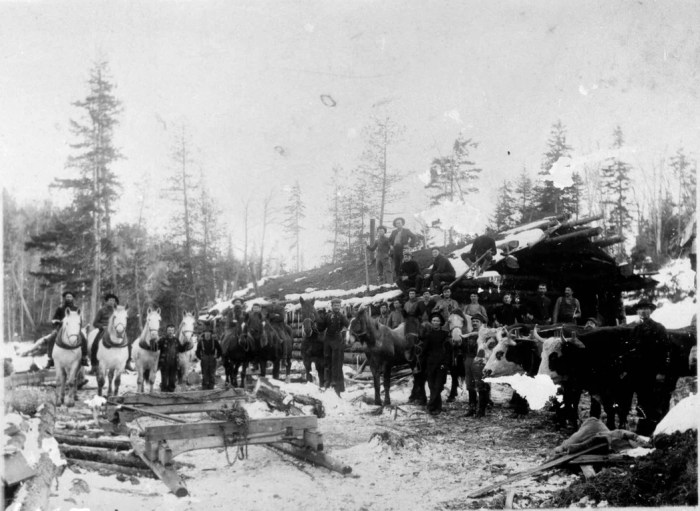
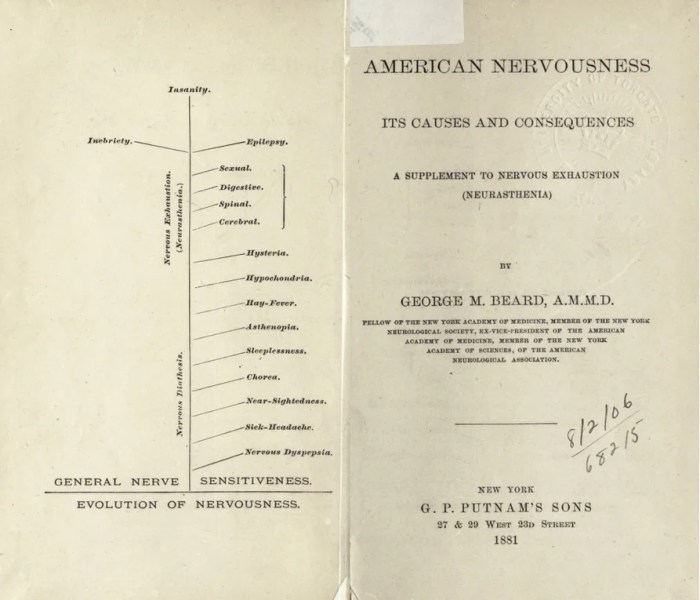
In addition to the gendered dimension of neurasthenia (the majority of those diagnosed were women), it was also seen as a particularly American disease, with some ever referring to the ailment as “Americanitis”. [George Miller] Beard was among those interested in the national character of neurasthenia, a concept he explored in his book American Nervousness (1881). “The greater prevalence of nervousness in America”, he writes, “is a complex resultant of a number of influences, the chief of which are the dryness of the air, extremes of heat and cold, civil and religious liberty, and the great mental activity made necessary and possible in a new and productive country under such climactic conditions.” Despite this capacious description of what it is that makes Americans nervous, Beard emphatically states that the Jumping Frenchmen do not qualify. While sufferers of neurasthenia appear tired and enervated, the lumberjacks of Moosehead Lake are “among the best examples of physical hardness and endurance”. Beard makes a distinction between “nervousness” and “unbalanced mental organization”, aligning the jumpers squarely with the latter category. The closest analogue Beard can find for the Jumping Frenchmen are “Middle Age epidemics”, like the so-called dancing plagues that periodically occurred in Europe during the late Middle Ages and early modern period. The victims of these epidemics had “but little intellectual strength and very much emotion”, a description that he implicitly associates with the Jumping Frenchmen as well. For Beard, the Jumping Frenchmen cannot suffer from modern American nervousness because — as Canadians, as francophones, and as rural laborers — they are not really modern Americans. Rather, they are “precious curiosities, relics or antiques that the fourteenth century has, as it were, dropped right into the middle of the nineteenth.” […]
… Beard finds an analogue for the jumpers in the hysterical epidemics of the Middle Ages, but also with the “Holy Rollers” of various religious revivals, who would roll on the ground in a state of uncontrollable religious ecstasy. While throwing a pipe or hitting your friend might seem very different from communing with the Holy Spirit, Beard sees them as deeply related, if distinct, forms of human behavior.
… While other forms of psychic or mass hysteria can last hours or days, the action of the jumpers is both immediate and short lived. “The explosion of the Jumper, like the explosion of a revolver, is sudden and instantaneous”, Beard writes. “If we look at a Jumper five seconds after he has been jumped, we see no indication of what he has just done.” The second key difference is “the persistence and permanence of the liability to be excited”. People tend to move on from other forms of psychic hysteria. Once the medieval peasants stop dancing, or the Holy Rollers stop rolling, they return to their regular lives. Not so the Jumping Frenchmen, for whom jumping is a lifelong condition. Beard considers that jumping may be hereditary — he notes that many of the jumpers he met belong to the same extended family. He also speculates that jumping may have been “an evolution of tickling”, noting that many jumpers are ticklish, and that jumpers deliberately prank one another “in lieu of most other sources of amusement”. But ultimately Beard concludes that “[e]verything about this subject is incredible.”
Also, an early line in the essay worth quoting:
After running through a list of symptoms typically associated with the Jumping Frenchmen — throwing, striking, jumping — Beard speculates that the jumpers may be “an extreme illustration of what we all are — that is, they possessed far less inhibitory power than we all possessed.