
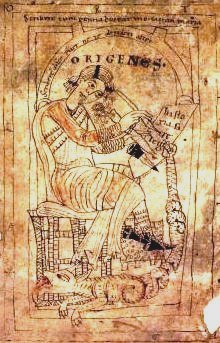
It is true that something remembered by tradition as “Origenism” was condemned by someone in the sixth century, and that Origen was maligned as a heretic in the process; and it is also true that for well more than a millennium both those decisions were associated with the Council of 553 by what was simply accepted as the official record. But, embarrassingly, we now know, and have known for quite some time, that the record was falsified. And this is a considerable problem not only for Orthodoxy, but for the Catholic Church as well, inasmuch as the authority of the ecumenical councils must in some way be intimately—if obscurely—bound to some notion of the indefectibility of the church’s transmission of the faith.
But, really, it is the most shameful episode in the history of Christian doctrine. For one thing, to have declared any man a heretic three centuries after dying in the peace of the church, in respect of doctrinal determinations not reached during his life, was a gross violation of all legitimate canonical order; but in Origen’s case it was especially loathsome. After Paul, there is no single Christian figure to whom the whole tradition is more indebted. It was Origen who taught the church how to read scripture as a living mirror of Christ, who evolved the principles of later Trinitarian theology and Christology, who majestically set the standard for Christian apologetics, who produced the first and richest expositions of contemplative spirituality, and who—simply said—laid the foundation of the whole edifice of developed Christian thought. Moreover, he was not only a man of extraordinary personal holiness, piety, and charity, but a martyr as well: Brutally tortured during the Decian persecution at the age of 69, he never recovered, but slowly withered away over a period of three years. He was, in short, among the greatest of the church fathers and the most illustrious of the saints and yet, disgracefully, official church tradition—East and West—commemorates him as neither.
I cannot really say what irks me more, though: that it happened or that, in fact, it really never did. The oldest records of the council (which was convened to deal solely with certain Antiochian theologians) make it clear that those fifteen anathemas were never even discussed by the assembled bishops, let alone ratified, published, or promulgated. And since the late nineteenth century various scholars have convincingly established that neither Origen nor “Origenism” was ever the subject of any condemnation pronounced by the “holy fathers” in 553. The best modern critical edition of the Seven Councils—Norman Tanner’s—simply omits the anathemas as spurious interpolations.
As for where they came from, the evidence suggests they were prepared beforehand by the vicious and insidiously stupid Emperor Justinian, who liked to play theologian, who saw the church as a pillar of imperial unity, and who took implacable umbrage at dissident theologies. A decade earlier, he had sent ten similar anathemas of Origen (or what he imagined Origen to have taught) to Patriarch Menas; and on the council’s eve he apparently submitted the fifteen anathemas of 553 to a lesser synod of bishops, in hope of securing some kind of ecclesial approbation for them. Or they may instead have been proposed at a synod as much as nine years before. Whatever the case, it was only well after the Fifth Ecumenical Council’s close that they were attached to its canons, and Origen’s name inserted into its list of condemned heretics. In this way the anathemas “went on the books,” where they remain: imposingly peremptory, garbed in immemorial authority, and false as hell.
[…] Even if the anathemas had actually been approved by the council, they no more constitute a serious condemnation of Origen than they do a recipe for brioche.
[…] East or West, all Christians are burdened with the absurdities of Christian imperial history. But any conception of orthodoxy that obliges one to grant the title of “saint” to a murderous thug like Justinian while denying it to a man as holy as Origen is obviously—indeed ludicrously—self-refuting. And one does not defend tradition well by making it appear not only atrociously unjust, but utterly ridiculous.