
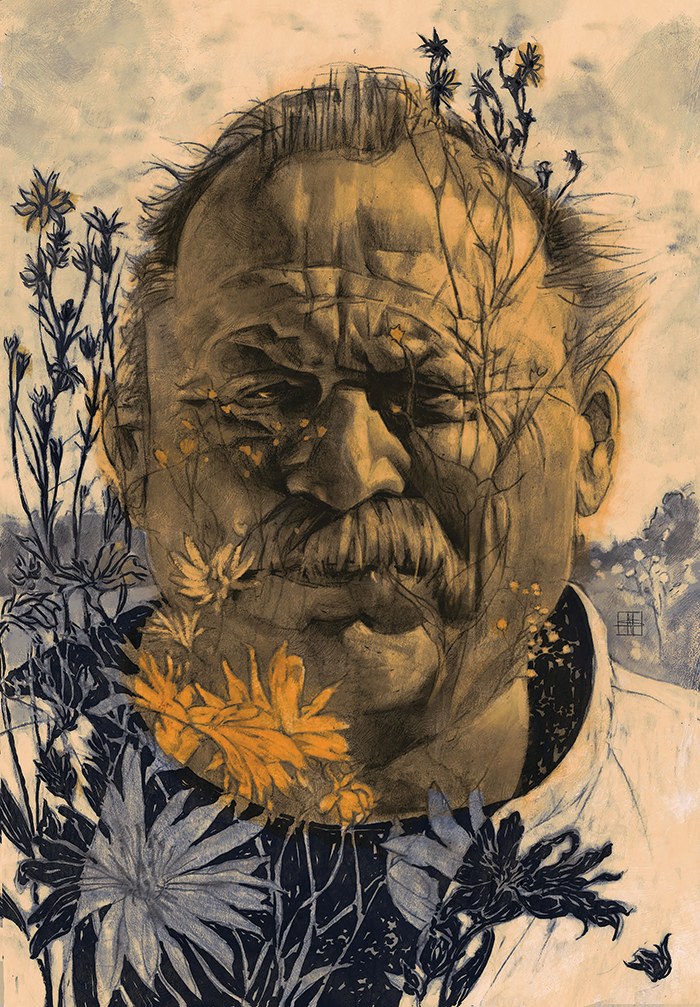
Nate Sweitzer, “The Mozart of the Prairies” (source)
Today, I am told, is the 10th anniversary of the death of Jim Harrison. The Substack The Poetic Outlaws has up a moving, and haunting, tribute to the man.
Though I have not been a wide reader of Harrison, I claim deep admiration. Braided Creek with Ted Kooser was one of the most instantly and naturally loveable books of poetry I’ve ever held.
Inspired this morning, and isolated to an upper corner of the house nursing the end of some flu-like thing, I picked up his splendid collection Dead Man’s Float. This is the opening poem:
Where is Jim Harrison?
He fell off the cliff of a seven-inch zafu.
He couldn’t get up because of his surgery.
He believes in the Resurrection mostly
because he was never taught how not to.
From a 1988 interview with Harrison (partially quoted in the Poetic Outlaws post above):
This idea of movement and the metaphor of the river, seem to be central to your work.
It’s the origin of the thinking behind The Theory and Practice of Rivers. In a life properly lived, you’re a river. You touch things lightly or deeply; you move along because life herself moves, and you can’t stop it; you can’t figure out a banal game plan applicable to all situations; you just have to go with the “beingness” of life, as Rilke would have it. In Sundog, Strang says a dam doesn’t stop a river, it just controls the flow. Technically speaking, you can’t stop one at all.
But you have to work at it, make a conscious effort so that your life flows like a river?
Antaeus magazine wanted me to write a piece for their issue about nature. I told them I couldn’t write about nature but that I’d write them a little piece about getting lost and all the profoundly good aspects of being lost—the immense fresh feeling of really being lost. I said there that my definition of magic in the human personality, in fiction and in poetry, is the ultimate level of attentiveness. Nearly everyone goes through life with the same potential perceptions and baggage, whether it’s marriage, children, education, or unhappy childhoods, whatever; and when I say attentiveness I don’t mean just to reality, but to what’s exponentially possible in reality. I don’t think, for instance, that Márquez is pushing it in One Hundred Years of Solitude—that was simply his sense of reality. The critics call this magic realism, but they don’t understand the Latin world at all. Just take a trip to Brazil. Go into the jungle and take a look around. This old Chippewa I know—he’s about seventy-five years old—said to me, “Did you know that there are people who don’t know that every tree is different from every other tree?” This amazed him. Or don’t know that a nation has a soul as well as a history, or that the ground has ghosts that stay in one area. All this is true, but why are people incapable of ascribing to the natural world the kind of mystery that they think they are somehow deserving of but have never reached? This attentiveness is your main tool in life, and in fiction, or else you’re going to be boring. As Rimbaud said, which I believed very much when I was nineteen and which now I’ve come back to, for our purposes as artists, everything we are taught is false—everything.
Here’s another from Dead Man’s Float:
The River
Yes, we’ll gather by the river,
the beautiful, the beautiful river.
They say it runs by the throne of God.
This is where God invented fish.
Wherever, but then God’s throne is as wide
as the universe. If you’re attentive you’ll
see the throne’s borders in the stars. We’re on this side
and when you get to the other side we don’t know
what will happen if anything. If nothing happens
we won’t know it, I said once. Is that cynical?
No, nothing is nothing, not upsetting just
nothing. Then again maybe we’ll be cast
at the speed of light through the universe
to God’s throne. His hair is bounteous.
All the 5,000 birds on earth were created there.
The firstborn cranes, herons, hawks, at the back
so as not to frighten the little ones.
Even now they remember this divine habitat.
Shall we gather at the river, this beautiful river?
We’ll sing with the warblers perched on his eyelashes.
If you don’t already love the man, take four minutes to watch this PBS recap of a 2009 interview with him. He was, or is in my imagination, like a more feral Malcolm Guite.
From Harrison’s poem “Bridge”:
Most of my life was spent
building a bridge out over the sea
though the sea was too wide.
I’m proud of the bridge
hanging in the pure sea air.…Sometimes the sea roars and howls like
the animal it is, a continent wide and alive.
What beauty in this darkest music
over which you can hear the lightest music of human
behavior, the tender connection between men and galaxies.So I sit on the edge, wagging my feet above
the abyss. Tonight the moon will be in my lap.
This is my job, to study the universe
from my bridge. I have the sky, the sea, the
faint green streak of Canadian forest on the far shore.
I didn’t know who Jim Harrison was when he died — back then, I didn’t know that he was or that he had died. He even sat on my own shelves for years, unknown to me, unknowingly collected and collecting dust.
Today I am happy — lucky and grateful — that he was and is here.